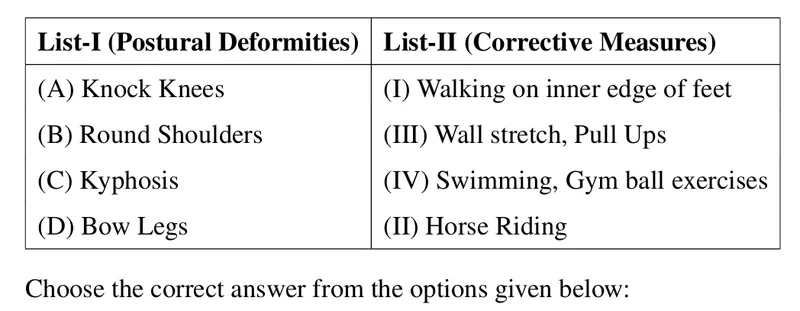
Match the postural deformities listed in List-I with their corrective measures listed in List-II:
Solution :
The correct option is (A)- (I), (B)- (III), (C)- (IV), (D)- (II).
Here is a detailed, step-by-step explanation of the matching between postural deformities and their corrective measures as shown in the table:
1. (A) Knock Knees matches with (I) Walking on inner edge of feet:
Knock knees (genu valgum) is a postural deformity where the knees bend inward and touch each other when standing, while the ankles remain apart. Walking on the inner edge of the feet (along with other specific foot/leg positioning exercises) helps in correcting the alignment and strengthening the muscles that support the knee joint.
2. (B) Round Shoulders matches with (III) Wall stretch, Pull Ups:
Round shoulders is a postural deformity in which the shoulders become hunched forward. Exercises like pull-ups and wall stretches help strengthen the posterior shoulder and upper back muscles (such as the rhomboids and trapezius) while stretching the tight chest muscles (pectorals), thereby pulling the shoulders back into their natural alignment.
3. (C) Kyphosis matches with (IV) Swimming, Gym ball exercises:
Kyphosis is an abnormal outward curvature of the upper thoracic spine, commonly referred to as a hunchback. Corrective measures include swimming (especially backstroke) and gym ball exercises (such as backward extensions over the ball), which help stretch the chest, strengthen the core and spinal extensors, and restore proper posture.
4. (D) Bow Legs matches with (II) Horse Riding:
Bow legs (genu varum) is a postural deformity where the knees remain wide apart when a person stands with their feet together, resulting in an outward curvature of the legs. Horse riding is a highly recommended corrective measure because the riding posture forces the knees inward to grip the horse, which helps counteract the outward bowing structure.
Completely free for students. Educators & coaching institutes get 2 months free Pro trial to create tests.
Access unlimited practice questions, detailed step-by-step solutions, and exam study materials — completely free for students.
Create and conduct professional online assessments with AI question generation, tab proctoring, and comprehensive batch management.

Prepare effectively with the CTET Paper 2 Set E (20th August 2023) Question Paper with Solutions. This previous year paper includes fully solved questions with detailed explanations to help you understand the latest CTET exam pattern, improve conceptual clarity, and strengthen your preparation for Child Development & Pedagogy, Language I, Language II, Mathematics & Science, or Social Studies/Social Science. Practicing this authentic CTET previous year paper will help you analyze question trends, improve time management, and boost your confidence for upcoming CTET examinations. The official August 2023 Paper 2 Set E question paper is available through the CTET archive.

Prepare for the CTET Paper 2 Set M (31st January 2021) Question Paper with Solutions to strengthen your exam preparation with authentic previous year questions. This solved paper provides detailed explanations for every question, helping you understand the latest CTET syllabus, question pattern, and marking scheme. It covers Child Development & Pedagogy, Language I, Language II, Mathematics & Science, and Social Studies/Social Science, making it an excellent practice resource for aspiring upper primary teachers. Solving this previous year paper will improve your conceptual understanding, accuracy, and time management for the upcoming CTET examination.
Copyright © 2026 Combe Labs Private Limited. All Rights Reserved.