Match the rate expressions in LIST-I for the decomposition of X with the corresponding profiles provided in LIST-II. Xs and k are constants having appropriate units.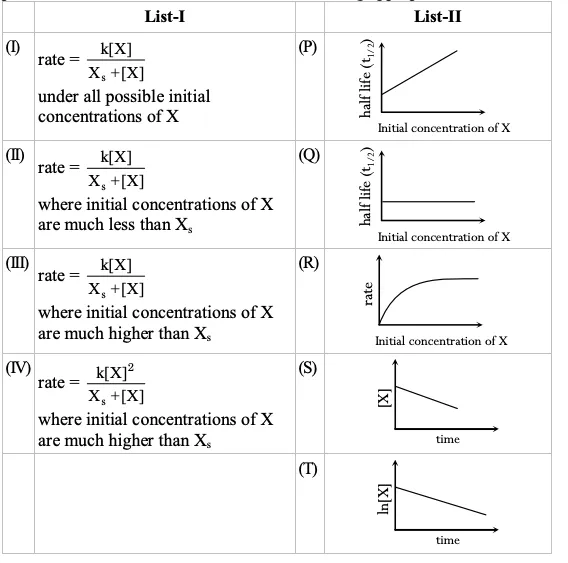
Correct Answer :
I → P; II → Q; III → S; IV → T
Solution :
The correct matching option is I → P; II → Q; III → S; IV → T.
Let us systematically analyze each rate expression in LIST-I and match it with its corresponding graphical profile in LIST-II based on reaction kinetics:
Analysis of (I):
Given rate expression:
under all possible initial concentrations of X.
When initial concentration [X]0 is small ([X]0 << Xs), denominator ≈ Xs, so rate = (k/Xs)[X], which is first-order kinetics (half-life is constant).
When initial concentration [X]0 is very large ([X]0 >> Xs), rate ≈ k, which is zero-order kinetics (half-life is directly proportional to initial concentration [X]0).
Therefore, as [X]0 increases, the overall half-life (t1/2) increases linearly from a constant value at very low concentration to an increasing function at higher concentration.
This corresponds to profile (P), which shows a plot of half-life (t1/2) vs Initial concentration of X with a positive slope starting from a non-zero intercept.
Analysis of (II):
Given rate expression:
where initial concentrations of X are much less than Xs ([X] << Xs).
In this limit:
This is a standard first-order reaction.
For a first-order reaction, the half-life is given by:
Thus, half-life is completely independent of the initial concentration of X.
This corresponds to profile (Q), showing a horizontal line for half life (t1/2) vs Initial concentration of X.
Analysis of (III):
Given rate expression:
where initial concentrations of X are much higher than Xs ([X] >> Xs).
In this limit:
This represents a zero-order reaction.
Integrating the rate equation gives:
A plot of [X] versus time yields a straight line with a negative slope (-k).
This corresponds to profile (S).
Analysis of (IV):
Given rate expression:
where initial concentrations of X are much higher than Xs ([X] >> Xs).
Since [X] >> Xs, the term (Xs + [X]) can be approximated as [X]:
This represents a first-order reaction with integrated rate law:
A plot of ln[X] versus time produces a straight line with a negative slope (-k).
This corresponds to profile (T).
Hence, the correct matching sequence is:
I → P
II → Q
III → S
IV → T
Access expert-curated educational resources and study materials—completely free.
Create, conduct, and manage professional online assessments with Mindyard. Perfect for teachers and institutes.
Copyright © 2026 Mindyard. All Rights Reserved.