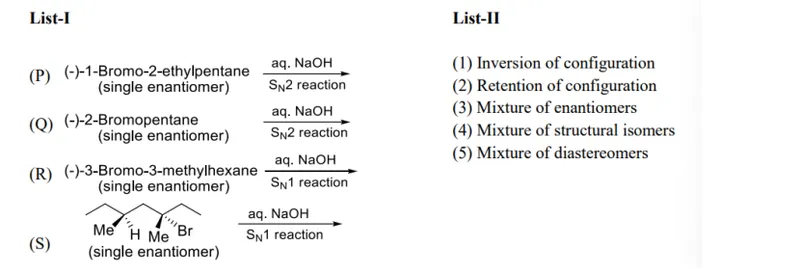
Match the reactions in List-I with the features of their products in List-II and choose the correct option.
Correct Answer :
P → 2; Q → 1; R → 3; S → 5
Solution :
Correct Option: P → 2; Q → 1; R → 3; S → 5
Let us analyze the chemical reactions in List-I step-by-step and match them with the stereochemical features of their products in List-II by inspecting the provided image.
1. Analysis of Reaction (P):
Reaction (P) gives the nucleophilic substitution: (-)-1-Bromo-2-ethylpentane (single enantiomer) + aq. NaOH via SN2 mechanism.
In 1-bromo-2-ethylpentane, the carbon attached to the leaving group (-Br) is a primary carbon (-CH2-Br), which is not a chiral center (stereocenter). The stereocenter exists at the C-2 position.
Since the substitution reaction (SN2) occurs exclusively at the primary carbon (C-1) and no bonds at the stereocenter (C-2) are broken or formed, the relative configuration at the chiral center remains unchanged.
Therefore, this reaction proceeds with Retention of configuration at the chiral center.
Hence, P → 2.
2. Analysis of Reaction (Q):
Reaction (Q) involves: (-)-2-Bromopentane (single enantiomer) + aq. NaOH via SN2 mechanism.
Here, the leaving group (-Br) is directly attached to the chiral carbon (C-2).
An SN2 reaction at a chiral center proceeds via a backside attack by the nucleophile (OH-), leading to complete inversion of stereochemistry.
Thus, the product shows Inversion of configuration.
Hence, Q → 1.
3. Analysis of Reaction (R):
Reaction (R) involves: (-)-3-Bromo-3-methylhexane (single enantiomer) + aq. NaOH via SN1 mechanism.
The starting substrate has a single chiral center at C-3.
In an SN1 reaction, the departure of the bromide ion forms a planar carbocation intermediate at C-3.
The nucleophile (OH-) can attack this planar carbocation equally from either face (front or back), yielding a 50:50 mixture of two enantiomers (racemic mixture).
Therefore, the product is a Mixture of enantiomers.
Hence, R → 3.
4. Analysis of Reaction (S):
Reaction (S) involves the SN1 reaction of a substrate with two chiral centers (a single enantiomer containing fixed stereochemistry at one center and a leaving group at the other chiral carbon).
During the SN1 process, the C-Br bond dissociates to form a planar carbocation at the carbon carrying the -Br group, while the other chiral center remains intact and unchanged.
Attack of the nucleophile on the planar carbocation forms two products with opposite configurations at the reaction site, while retaining identical configuration at the unchanged chiral center.
Two stereoisomers that differ in configuration at one stereocenter but are identical at another are diastereomers.
Thus, the product is a Mixture of diastereomers.
Hence, S → 5.
Conclusion:
Matching all entries:
P → 2
Q → 1
R → 3
S → 5
Access expert-curated educational resources and study materials—completely free.
Create, conduct, and manage professional online assessments with Mindyard. Perfect for teachers and institutes.
Copyright © 2026 Mindyard. All Rights Reserved.