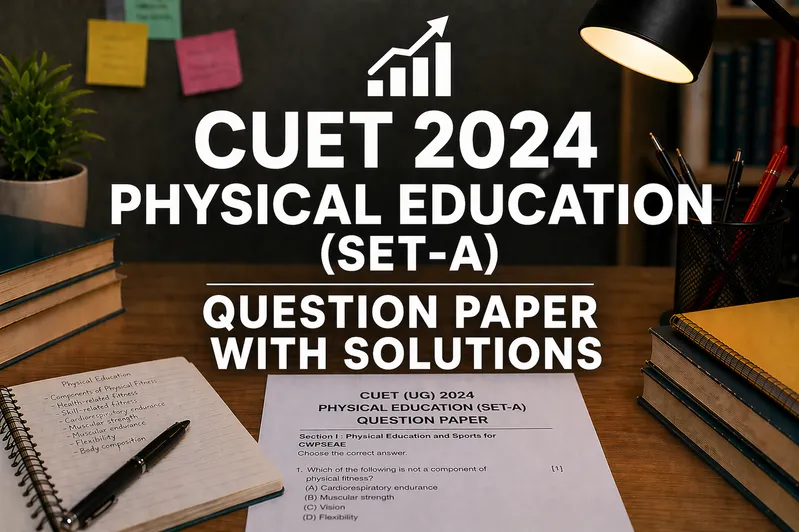
Match the types/steps involved in organizing a tournament listed in List-I with their correct associations listed in List-II:
Choose the correct answer from the options given below:
Solution :
The correct option is (A)- (I), (B)- (II), (C)- (III), (D)- (IV).
Let us understand and match each concept step-by-step:
1. (A) Bye − (I) Advantage given to team not playing the first round
A "Bye" is a privilege or advantage granted to a team in a tournament. It allows the team to advance directly to the second round without having to play or compete in the first round.
2. (B) Knock-out − (II) Team eliminated after first defeat
A "Knock-out" (or single-elimination) tournament is a type of competition where a team is immediately eliminated from the tournament upon losing a single match. Only the winning team advances to the next round.
3. (C) Number of byes − (III) Next highest power of 2 − number of teams
To ensure a smooth bracket progression in a knock-out tournament, the number of teams participating must be a power of 2. If the number of teams is not a power of 2, byes are given. The formula to calculate the total number of byes is:
where represents the next highest power of 2 greater than or equal to the total number of teams .
4. (D) Number of teams in upper half (odd teams) − (IV) (Number of teams + 1)/2
When organizing a tournament with an odd number of teams (), the teams are divided into two halves. Since the division is uneven, the upper half receives one extra team. The formula to calculate the number of teams in the upper half is:
which corresponds to (Number of teams + 1)/2.
Completely free for students. Educators & coaching institutes get 2 months free Pro trial to create tests.
Access unlimited practice questions, detailed step-by-step solutions, and exam study materials — completely free for students.
Create and conduct professional online assessments with AI question generation, tab proctoring, and comprehensive batch management.
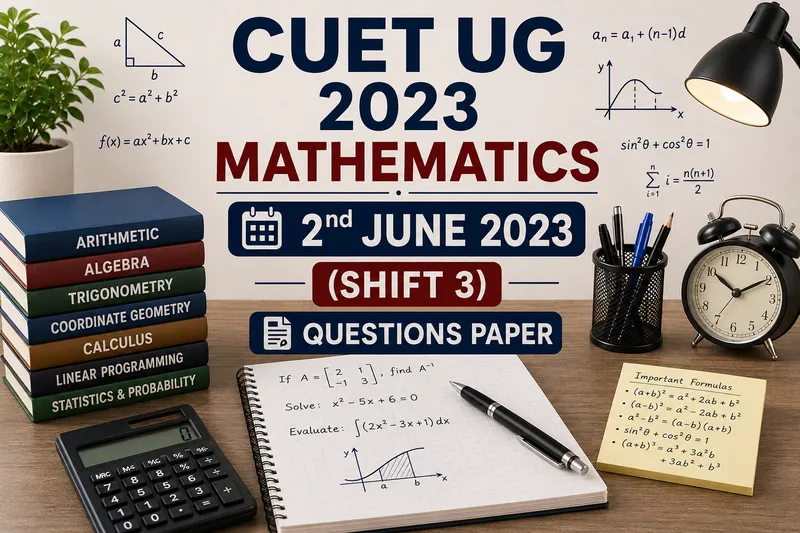
A comprehensive CUET UG Mathematics Question Paper with Solutions – 2 June 2023 (Shift 3) designed to help students practice and understand the actual CUET exam pattern. This paper covers important topics from Algebra, Calculus, Coordinate Geometry, Probability, Statistics, Matrices, Determinants, and Vectors, featuring a balanced mix of conceptual, numerical, and application-based questions. Detailed solutions are provided to strengthen problem-solving skills, improve conceptual clarity, and enhance calculation accuracy. Based on the CUET syllabus and previous year exam trends, this paper is ideal for practice, revision, self-assessment, time management, previous year analysis, and final preparation for upcoming CUET UG Mathematics examinations.
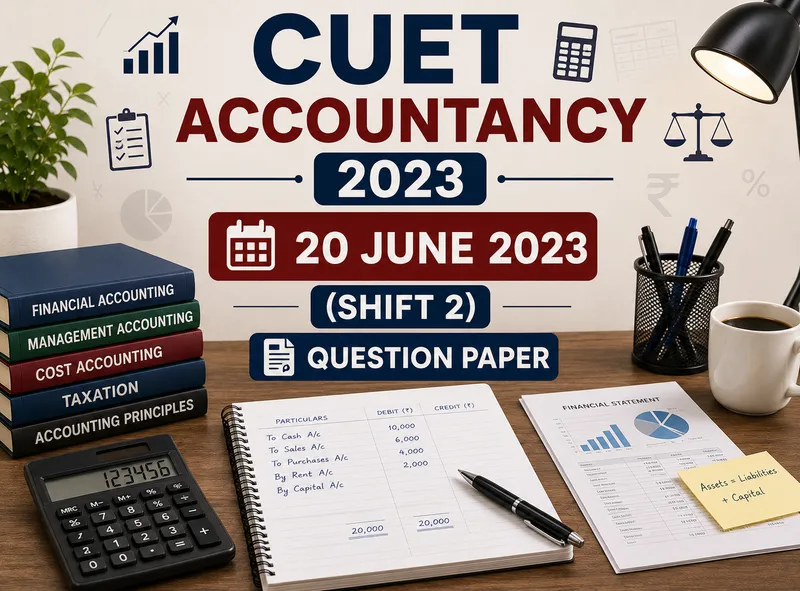
A comprehensive CUET Accountancy Question Paper – 20 June 2023 (Shift 2) designed to help students practice and analyze previous year exam patterns for effective CUET preparation. This paper covers important topics including Accounting for Partnership Firms, Company Accounts, Financial Statements Analysis, Cash Flow Statements, Accounting Ratios, and Fundamental Accounting Principles. It features a balanced mix of conceptual, numerical, and application-based questions to strengthen accounting concepts, improve calculation accuracy, and enhance problem-solving skills. Based on the CUET exam structure and syllabus, this paper is ideal for practice, revision, self-assessment, time management, previous year analysis, and final preparation for upcoming CUET Accountancy examinations.
Copyright © 2026 Combe Labs Private Limited. All Rights Reserved.