Monocyclic compounds P, Q, R and S are the major products formed in the reaction sequences
given below.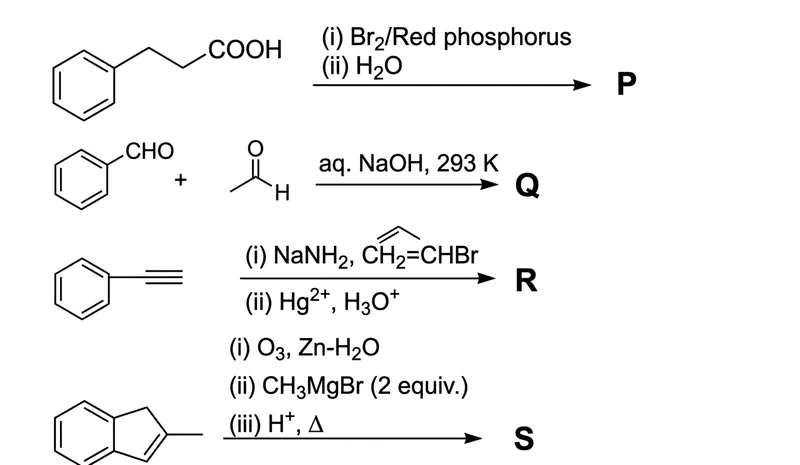
Correct Answer :
S
Solution :
The correct option is S.
To determine which of the monocyclic compounds P, Q, R, and S contains the highest number of unsaturated carbon atoms, we will trace the reaction pathways for each sequence and count the number of and hybridized carbon atoms (carbons involved in double or triple bonds) in each major product.
1. Formation of P:
The reactant is 3-phenylpropanoic acid:
Reagents: (i) / Red phosphorus, (ii) .
This is the Hell-Volhard-Zelinsky (HVZ) reaction, which selectively brominates the carboxylic acid at the -position.
The product P is 2-bromo-3-phenylpropanoic acid:
Unsaturated carbon atoms in P:
- 6 carbon atoms from the benzene ring ()
- 1 carbonyl carbon from the carboxylic acid group ()
Total unsaturated carbons in P = 6 + 1 = 7.
2. Formation of Q:
Reactants: Benzaldehyde () + Acetaldehyde ().
Reagents: aq. NaOH, 293 K.
This is a crossed-aldol condensation (Claisen-Schmidt reaction). Since benzaldehyde has no -hydrogens, it acts as the electrophile, while the enolate generated from acetaldehyde attacks it. Dehydration of the aldol intermediate gives cinnamaldehyde.
The product Q is cinnamaldehyde:
Unsaturated carbon atoms in Q:
- 6 carbon atoms from the benzene ring ()
- 2 alkene carbon atoms ()
- 1 carbonyl carbon from the aldehyde group ()
Total unsaturated carbons in Q = 6 + 2 + 1 = 9.
3. Formation of R:
Reactants: Phenylacetylene () and vinyl bromide ().
Reagents: (i) , ; (ii) .
- Step 1: deprotonates the terminal alkyne of phenylacetylene to form a sodium acetylide nucleophile, which couples with vinyl bromide to yield the enyne intermediate 1-phenylbut-3-en-1-yne ().
- Step 2: Hydration of the alkyne group catalyzed by gives a ketone via Markovnikov addition.
The product R is 1-phenylbut-3-en-1-one:
Unsaturated carbon atoms in R:
- 6 carbon atoms from the benzene ring ()
- 1 carbonyl carbon from the ketone group ()
- 2 alkene carbon atoms from the terminal vinyl group ()
Total unsaturated carbons in R = 6 + 1 + 2 = 9.
4. Formation of S:
Reactant: 2-methyl-1H-indene (a bicyclic system containing a benzene ring fused to a cyclopentene ring with a methyl group at C-2).
Reagents: (i) , ; (ii) (2 equiv.); (iii) .
- Step 1: Reductive ozonolysis cleaves the cyclopentene double bond, converting the bicyclic compound into a monocyclic dicarbonyl compound with a benzene ring substituted by a group and a group.
- Step 2: Grignard addition of 2 equivalents of methylmagnesium bromide to the two carbonyl groups (one aldehyde and one ketone) converts them into secondary and tertiary alcohols, respectively:
and
- Step 3: Acid-catalyzed double dehydration () removes two molecules of water from the side chains, forming two double bonds.
The monocyclic product S is 1-(isopropenyl)-2-(prop-1-en-1-yl)benzene:
Unsaturated carbon atoms in S:
- 6 carbon atoms from the benzene ring ()
- 2 alkene carbon atoms from the isopropenyl substituent ()
- 2 alkene carbon atoms from the propenyl substituent ()
Total unsaturated carbons in S = 6 + 2 + 2 = 10.
Comparing the counts of unsaturated carbons in each product:
- P: 7
- Q: 9
- R: 9
- S: 10
Therefore, the monocyclic compound containing the highest number of unsaturated carbon atoms is S.
Access expert-curated educational resources and study materials—completely free.
Create, conduct, and manage professional online assessments with Mindyard. Perfect for teachers and institutes.
Copyright © 2026 Mindyard. All Rights Reserved.