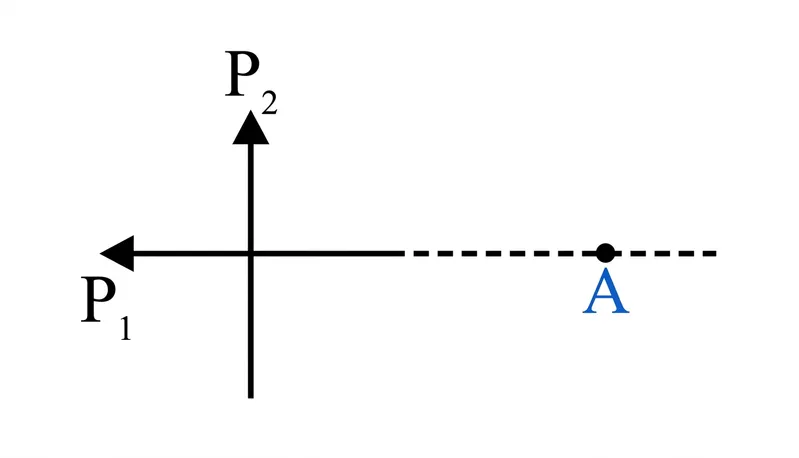
Net electric field at point A as shown in figure is at an angle of 60◦ with x-axis. Find P2 /P1 .
Correct Answer :
Solution :
The correct answer is:
Step-by-Step Explanation:
1. Identify the dipoles and point A from the image:
From the given diagram, we have two short dipoles placed at the origin:
- Dipole 1 has a dipole moment vector pointing in the negative x-direction (leftward), so:
- Dipole 2 has a dipole moment vector pointing in the positive y-direction (upward), so:
Point A lies on the positive x-axis at a distance from the origin.
2. Electric field due to Dipole 1 at point A:
Since point A lies along the axis of dipole 1, the electric field is in the axial position. The axial electric field of a dipole is directed parallel to the dipole moment vector:
where .
3. Electric field due to Dipole 2 at point A:
Since point A lies on the perpendicular bisector (equatorial line) of dipole 2, the electric field is in the equatorial position. The equatorial electric field of a dipole is directed opposite to the dipole moment vector:
4. Net electric field at point A:
The net electric field vector is the vector sum of both fields:
5. Angle of the net electric field with the x-axis:
Since both the x and y components of the electric field are negative, the net field points into the third quadrant. The magnitude of the angle it makes with the x-axis is given by:
Substituting the values of and :
Simplifying the ratio:
Solving for the ratio :
Access expert-curated educational resources and study materials—completely free.
Create, conduct, and manage professional online assessments with Mindyard. Perfect for teachers and institutes.
Copyright © 2026 Mindyard. All Rights Reserved.