
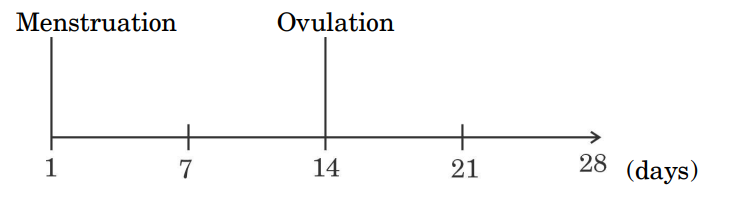
Observe the following line diagram depicting the 28 days menstrual cycle of a healthy young woman.
Solution :
The correct options are:
1. Most fertile days : 14 - 21 , Least fertile days : 1 - 7
2. Most fertile days : 10 - 17 , Least fertile days : 21 - 28
Explanation:
The provided line diagram represents a typical 28-day menstrual cycle of a healthy woman, showing key landmarks:
1. Menstruation (Days 1–7): This marks the beginning of the menstrual cycle where the uterine lining is shed.
2. Ovulation (Day 14): The release of a mature egg from the ovary occurs at the midpoint of the cycle, around Day 14.
1. Why "Most fertile days : 10 - 17 , Least fertile days : 21 - 28" is correct:
- Most Fertile Days (Days 10–17): The biological fertile window is determined by the lifespan of the sperm (up to 5 days in the female reproductive tract) and the lifespan of the ovulated egg (about 12 to 24 hours). Since ovulation occurs on Day 14, the days leading up to it (from Day 10) and shortly after it (until Day 17) constitute the period of peak fertility.
- Least Fertile Days (Days 21–28): After Day 17, the egg has degenerated if not fertilized, and the corpus luteum enters its secretory/luteal phase. Without a viable egg, pregnancy cannot occur, making the last week of the cycle (Days 21–28) the safest or least fertile period.
2. Why "Most fertile days : 14 - 21 , Least fertile days : 1 - 7" is correct:
- Most Fertile Days (Days 14–21): In some curriculum standards, the week immediately starting from the day of ovulation (Day 14 to Day 21) is highlighted as the fertile phase because the egg is released at Day 14 and remains receptive/viable for fertilization in the early part of this window.
- Least Fertile Days (Days 1–7): During active menstruation (Days 1–7), the uterine lining is shedding and no mature egg is present for fertilization, representing a phase of very low fertility.
Completely free for students. Educators & coaching institutes get 2 months free Pro trial to create tests.
Access unlimited practice questions, detailed step-by-step solutions, and exam study materials — completely free for students.
Create and conduct professional online assessments with AI question generation, tab proctoring, and comprehensive batch management.

Prepare effectively with the CBSE Class 12 Biology 2022–23 Set - 1 Question Paper. This paper is ideal for students appearing for the CBSE Class 12 Board Examination and helps in understanding the latest exam pattern, question types, and marking scheme. Practice with authentic board-level questions to improve accuracy, time management, and conceptual clarity. The paper includes detailed solutions to help you analyze your performance and strengthen important Biology concepts before the exam.

Practice with the CBSE Class 12 Biology 2022–23 Set - 2 Question Paper to strengthen your preparation for the CBSE Board Examination. This previous year question paper follows the latest CBSE exam pattern and includes a variety of board-level questions covering Genetics, Evolution, Biotechnology, Human Physiology, Reproduction, Ecology, and other important topics. Detailed solutions help you understand the correct approach, improve conceptual clarity, and enhance time management for the final exam. Solving this paper is an excellent way to evaluate your preparation and boost your confidence before the board examination.
Copyright © 2026 Combe Labs Private Limited. All Rights Reserved.
 Set - 3-1782888548748.webp)

