
Observe the following reaction sequence:
C4H8 (A) → HCl → C4H9Cl (B) → NH3 → C4H9NH2 (C) (Optically active)
C4H9NH2 → NaNO2 + HCl → C4H9OH
Which of the following is correct structure of A, B and C?
Options
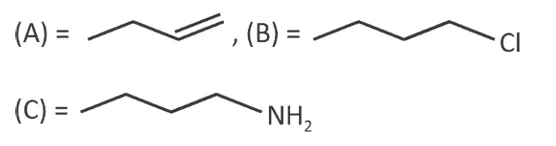 .
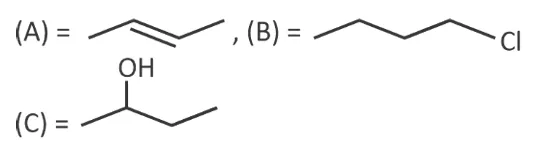 .
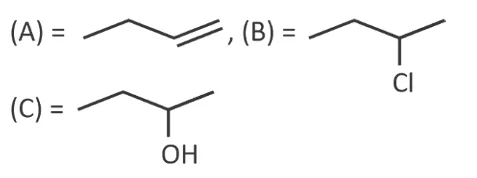 .
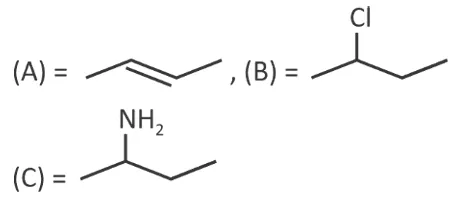 .
.Solution :
The correct option is Option 4 (represented by the structures in the fourth image).
Step-by-Step Explanation:
1. Identification of Compound A:
The starting compound A has the molecular formula , which indicates it is an alkene. Based on the options, A can be either 1-butene or 2-butene.
2. Reaction of A with HCl to form B:
When 2-butene () reacts with , it undergoes electrophilic addition to yield 2-chlorobutane (B):
3. Reaction of B with NH3 to form C:
When 2-chlorobutane (B) reacts with ammonia (), a nucleophilic substitution reaction occurs, replacing the chlorine atom with an amino group to yield 2-aminobutane (C):
4. Optical Activity of Compound C:
The product 2-aminobutane (sec-butylamine) contains a chiral carbon atom at C-2, which is bonded to four different groups: a hydrogen atom (), a methyl group (), an ethyl group (), and an amino group (). Because of this asymmetric carbon, 2-aminobutane is optically active, which matches the problem description.
5. Reaction of C with NaNO2 + HCl:
The reaction of primary aliphatic amines with nitrous acid () forms an unstable diazonium salt, which undergoes hydrolysis to yield the corresponding alcohol, 2-butanol ().
6. Analyzing the Provided Options:
- Option 1 (image_0): Shows A as 1-butene, B as 1-chlorobutane, and C as 1-aminobutane (which is optically inactive).
- Option 2 (image_1): Shows C as 2-butanol instead of the amine.
- Option 3 (image_2): Shows C as 2-butanol instead of the amine.
- Option 4 (image_3): Shows A as 2-butene, B as 2-chlorobutane, and C as 2-aminobutane. This is the correct structural match.
Completely free for students. Educators & coaching institutes get 2 months free Pro trial to create tests.
Access unlimited practice questions, detailed step-by-step solutions, and exam study materials — completely free for students.
Create and conduct professional online assessments with AI question generation, tab proctoring, and comprehensive batch management.

A comprehensive JEE Advanced 2022 Paper 1 designed to help aspirants understand the examination pattern, difficulty level, and question trends of JEE Advanced. This paper covers important concepts from Physics, Chemistry, and Mathematics, featuring a balanced mix of conceptual, numerical, and advanced application-based questions. It helps students strengthen conceptual understanding, enhance analytical and problem-solving skills, and improve speed and accuracy. Ideal for practice, revision, self-assessment, previous year trend analysis, concept reinforcement, and time management, this paper is a valuable resource for effective JEE Advanced preparation.

A comprehensive JEE Advanced 2022 Paper 2 designed to help aspirants understand the examination pattern, difficulty level, and question trends of JEE Advanced. This paper covers important concepts from Physics, Chemistry, and Mathematics, featuring a balanced mix of conceptual, numerical, and advanced application-based questions. It helps students strengthen conceptual understanding, enhance analytical and problem-solving skills, and improve speed and accuracy. Ideal for practice, revision, self-assessment, previous year trend analysis, concept reinforcement, and time management, this paper is a valuable resource for effective JEE Advanced preparation.
Copyright © 2026 Combe Labs Private Limited. All Rights Reserved.


