Observe the following reaction sequence:
(P) —NH3, Δ→ (Q) —Br2/KOH→ (R)
Which of the following is the correct structure for P, Q and R?
Options
 .
.
 .
.
 .
.
 .
.
Correct Answer :
.
Solution :
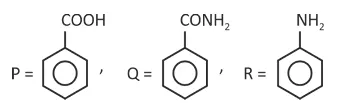
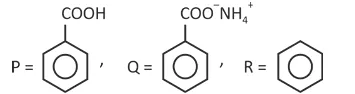
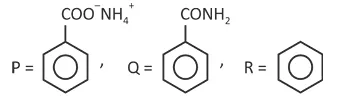
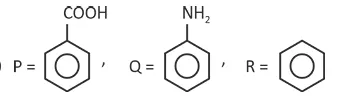
Correct Option: The first option (corresponding to the structures shown in the first image, where P is benzoic acid, Q is benzamide, and R is aniline).
Step-by-Step Explanation:
1. Conversion of P to Q:
When a carboxylic acid is treated with ammonia (NH3) followed by heating (represented by Δ), it undergoes a nucleophilic acyl substitution followed by thermal dehydration.
Initially, the carboxylic acid reacts with ammonia in an acid-base reaction to form an ammonium carboxylate salt:
C6H5COOH + NH3 → C6H5COO-NH4+
Upon heating (Δ), this salt undergoes dehydration (loss of a water molecule, H2O) to yield a primary amide (benzamide):
C6H5COO-NH4+ —Δ→ C6H5CONH2 + H2O
Therefore, starting material P is benzoic acid (C6H5COOH) and product Q is benzamide (C6H5CONH2).
2. Conversion of Q to R:
When benzamide (Q) is treated with bromine in the presence of potassium hydroxide (Br2/KOH), it undergoes the Hoffmann Bromamide Degradation reaction.
In this reaction, the primary amide is converted into a primary amine containing one carbon atom less than the starting amide via an isocyanate intermediate:
C6H5CONH2 + Br2 + 4KOH → C6H5NH2 + K2CO3 + 2KBr + 2H2O
Thus, the primary amide group (-CONH2) is degraded to an amine group (-NH2). The resulting product R is aniline (C6H5NH2).
Conclusion:
Analyzing the structures shown in the provided images:
• P: Benzoic acid (benzene ring attached to -COOH)
• Q: Benzamide (benzene ring attached to -CONH2)
• R: Aniline (benzene ring attached to -NH2)
These structures correspond exactly to the first option.
Access expert-curated educational resources and study materials—completely free.
Create, conduct, and manage professional online assessments with Mindyard. Perfect for teachers and institutes.
Copyright © 2026 Mindyard. All Rights Reserved.