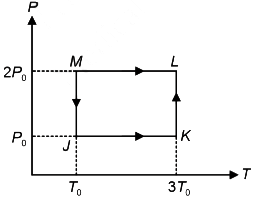
One mole of a monatomic ideal gas undergoes the cyclic process J→ K→ L→ M→ J, as shown in the P-T diagram.
Match the quantities mentioned in List-I with their values in List-II and choose the correct option.
[ℛ is the gas constant.]
| List-I | List-II |
| (P) Work done in the complete cyclic process |
(1) |
| (Q) Change in the internal energy of the gas in the process JK |
(2) 0 |
| (R) Heat given to the gas in the process KL |
(3) |
| (S) Change in the internal energy of the gas in the process MJ |
(4) |
| (5) |
Correct Answer :
P → 4; Q → 3; R → 5; S → 2
Solution :
Correct Option: P → 4; Q → 3; R → 5; S → 2
Let us analyze the cyclic process for mole of a monatomic ideal gas as shown in the pressure-temperature () diagram.
For a monatomic ideal gas:
The molar heat capacity at constant volume is:
The molar heat capacity at constant pressure is:
1. Analysis of individual processes:
Process J → K: Isobaric heating
From the diagram, the pressure is constant at , and the temperature increases from to .
The change in internal energy () is given by:
Thus, (Q) → (3).
The work done during this process is:
Process K → L: Isothermal compression
From the diagram, the temperature remains constant at , and the pressure increases from to .
Since the temperature is constant, the change in internal energy is .
The heat given to the gas () is equal to the work done ():
Thus, (R) → (5).
Process L → M: Isobaric cooling
The pressure is constant at , and the temperature decreases from to .
The work done during this process is:
Process M → J: Isothermal expansion
The temperature remains constant at , and the pressure decreases from to .
Since this is an isothermal process, the change in internal energy is:
Thus, (S) → (2).
The work done in this process is:
2. Work done in the complete cyclic process:
The net work done () is the sum of the work done in each stage:
Substituting the calculated work values:
Simplifying:
Thus, (P) → (4).
Conclusion:
Matching the items from List-I with List-II:
P → 4
Q → 3
R → 5
S → 2
This corresponds directly to the option: P → 4; Q → 3; R → 5; S → 2.
Access expert-curated educational resources and study materials—completely free.
Create, conduct, and manage professional online assessments with Mindyard. Perfect for teachers and institutes.
Copyright © 2026 Mindyard. All Rights Reserved.