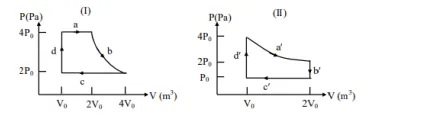
One mole of an ideal gas undergoes two different cyclic processes I and II, as shown in the P − V diagrams below. In cycle I, processes a, b, c, d are isobaric, isothermal, isobaric, and isochoric, respectively. In cycle II, processes a′, b′, c′, d′ are isothermal, isochoric, isobaric, and isochoric, respectively. The total work done during cycle I is WI and that during cycle II is WII. The ratio is .
Correct Answer :
Solution :
The correct answer is 2.
Let us analyze the P - V diagrams for both cyclic processes step-by-step to calculate the total work done in each cycle.
1. Calculation of Work Done in Cycle I (WI):
Cycle I consists of four processes: a, b, c, and d.
• Process a (Isobaric expansion):
Pressure is constant at P = 4P0 as volume goes from V0 to 2V0.
• Process b (Isothermal expansion):
The gas expands isothermally at initial state (4P0, 2V0) to final pressure 2P0.
Since P1V1 = P2V2, we have:
(4P0)(2V0) = (2P0)(Vfinal) ⇒ Vfinal = 4V0.
Work done in isothermal expansion:
• Process c (Isobaric compression):
Pressure is constant at P = 2P0 while volume decreases from 4V0 back to V0.
• Process d (Isochoric process):
Volume remains constant at V0, so no work is done:
The total work done in Cycle I is:
2. Calculation of Work Done in Cycle II (WII):
Cycle II consists of four processes: a′, b′, c′, and d′.
• Process a′ (Isothermal expansion):
Starts at state (4P0, V0) and expands isothermally to volume 2V0.
Since P1V1 = P2V2, final pressure is 2P0.
Work done:
• Process b′ (Isochoric process):
Volume is constant at 2V0 as pressure drops from 2P0 to P0.
• Process c′ (Isobaric compression):
Pressure is constant at P = P0 as volume goes from 2V0 to V0.
• Process d′ (Isochoric process):
Volume remains constant at V0.
The total work done in Cycle II is:
3. Calculating the Ratio:
Taking the ratio of WI to WII:
Hence, the ratio is equal to 2.
Access expert-curated educational resources and study materials—completely free.
Create, conduct, and manage professional online assessments with Mindyard. Perfect for teachers and institutes.
Copyright © 2026 Mindyard. All Rights Reserved.