
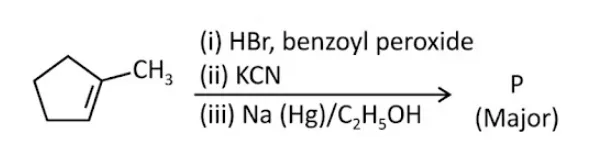
Predict the major product ‘P’ in the following sequence of reactions-
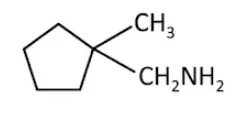
Options
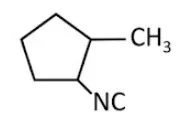
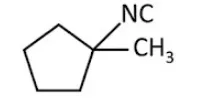
Solution :
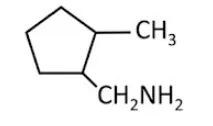
The correct option is the fourth option (Option 4), which represents 1-methyl-2-(aminomethyl)cyclopentane (or (2-methylcyclopentyl)methanamine).
Let us break down the reaction sequence step-by-step to understand how the major product ��P’ is formed:
Step 1: Anti-Markovnikov addition of HBr (Kharasch effect)
When 1-methylcyclopentene (a cyclopentene ring with a methyl substituent on one of the double-bonded carbons, C1) is treated with hydrogen bromide (HBr) in the presence of benzoyl peroxide, the reaction proceeds via a free-radical chain mechanism:
1. The peroxide initiator decomposes to form free radicals, which react with HBr to generate a bromine radical:
2. The bromine radical attacks the alkene double bond. It selectively adds to the less-substituted carbon (C2) to form a more stable tertiary radical at the C1 position (bearing the methyl group) rather than a secondary radical.
3. The tertiary radical then abstracts a hydrogen atom from a molecule of HBr, yielding the anti-Markovnikov product:
1-bromo-2-methylcyclopentane
Step 2: Nucleophilic Substitution ( reaction)
When 1-bromo-2-methylcyclopentane is reacted with potassium cyanide (KCN):
The cyanide ion () acts as a nucleophile and undergoes nucleophilic substitution, replacing the bromide ion () at the secondary carbon (C2). This yields:
1-cyano-2-methylcyclopentane (2-methylcyclopentanecarbonitrile)
Step 3: Mendius Reduction of the Nitrile
Treating the nitrile with sodium amalgam in ethanol () reduces the nitrile group () to a primary amine group ():
This Mendius reduction converts 1-cyano-2-methylcyclopentane into:
1-methyl-2-(aminomethyl)cyclopentane (also named (2-methylcyclopentyl)methanamine), where the methyl group () and the aminomethyl group () are located on adjacent carbons of the cyclopentane ring.
This structure corresponds directly to the one shown in Option 4 (Image 4).
Completely free for students. Educators & coaching institutes get 2 months free Pro trial to create tests.
Access unlimited practice questions, detailed step-by-step solutions, and exam study materials — completely free for students.
Create and conduct professional online assessments with AI question generation, tab proctoring, and comprehensive batch management.

A comprehensive JEE Advanced 2022 Paper 1 designed to help aspirants understand the examination pattern, difficulty level, and question trends of JEE Advanced. This paper covers important concepts from Physics, Chemistry, and Mathematics, featuring a balanced mix of conceptual, numerical, and advanced application-based questions. It helps students strengthen conceptual understanding, enhance analytical and problem-solving skills, and improve speed and accuracy. Ideal for practice, revision, self-assessment, previous year trend analysis, concept reinforcement, and time management, this paper is a valuable resource for effective JEE Advanced preparation.

A comprehensive JEE Advanced 2022 Paper 2 designed to help aspirants understand the examination pattern, difficulty level, and question trends of JEE Advanced. This paper covers important concepts from Physics, Chemistry, and Mathematics, featuring a balanced mix of conceptual, numerical, and advanced application-based questions. It helps students strengthen conceptual understanding, enhance analytical and problem-solving skills, and improve speed and accuracy. Ideal for practice, revision, self-assessment, previous year trend analysis, concept reinforcement, and time management, this paper is a valuable resource for effective JEE Advanced preparation.
Copyright © 2026 Combe Labs Private Limited. All Rights Reserved.


