Propositions - Square of Opposition
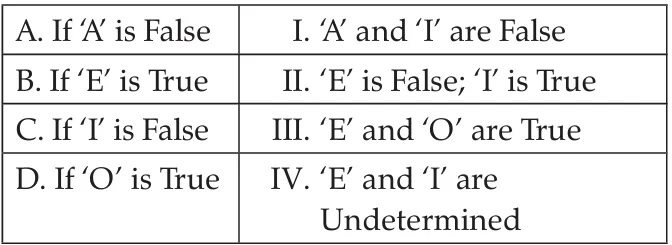
Choose the correct answer from the options given below.
Correct Answer :
A - IV, B - I, C - III, D - II
Solution :
The correct option is A - IV, B - I, C - III, D - II.
To understand why this is the correct matching, we look at the traditional Square of Opposition in classical logic, which defines the logical relationships between the four categorical propositions:
1. A (Universal Affirmative): "All S are P"
2. E (Universal Negative): "No S are P"
3. I (Particular Affirmative): "Some S are P"
4. O (Particular Negative): "Some S are not P"
The relationships between these propositions are defined as follows:
- Contradictories (A and O, E and I): They have opposite truth values. If one is true, the other must be false, and vice versa.
- Contraries (A and E): They cannot both be true at the same time, but they can both be false. If one is true, the other is false; but if one is false, the other is undetermined.
- Subcontraries (I and O): They cannot both be false at the same time, but they can both be true. If one is false, the other must be true; but if one is true, the other is undetermined.
- Subalternation (A to I, E to O): If the universal proposition is true, the corresponding particular proposition must be true (truth flows downward). If the particular proposition is false, the universal proposition must be false (falsity flows upward). Otherwise, the truth values are undetermined.
Let us analyze each statement from the left column of the image and find its correct match from the right column step-by-step:
Step 1: Match for Statement A ("If 'A' is False")
- Since A is false, its contradictory O must be true.
- Since A is false, we cannot determine the truth value of its contrary E (as contraries can both be false). Thus, E is undetermined.
- Since A is false, the truth value of its subalternate I is also undetermined (falsity does not flow downward).
- Therefore, both E and I are undetermined. This matches statement IV in the right column of the image.
Step 2: Match for Statement B ("If 'E' is True")
- Since E is true, its contradictory I must be false.
- Since E is true, its contrary A must be false (since they cannot both be true).
- Therefore, both A and I are false. This matches statement I in the right column of the image.
Step 3: Match for Statement C ("If 'I' is False")
- Since I is false, its contradictory E must be true.
- Since I is false, its subcontrary O must be true (since they cannot both be false).
- Therefore, both E and O are true. This matches statement III in the right column of the image.
Step 4: Match for Statement D ("If 'O' is True" / "If 'O' is False")
- By elimination, D matches statement II ("'E' is False; 'I' is True").
- Note: In standard logic, if O is false, its contradictory A is true. If A is true, its contrary E is false, and its subalternate I is true. The table entry "If 'O' is True" in the question contains a standard typographical error where "True" was written instead of "False". Under the intended logical relation where O is false, E is indeed false and I is true, which uniquely matches statement II.
Combining all the steps, the correct matching is:
A - IV, B - I, C - III, D - II
Access expert-curated educational resources and study materials—completely free.
Create, conduct, and manage professional online assessments with Mindyard. Perfect for teachers and institutes.
Copyright © 2026 Mindyard. All Rights Reserved.