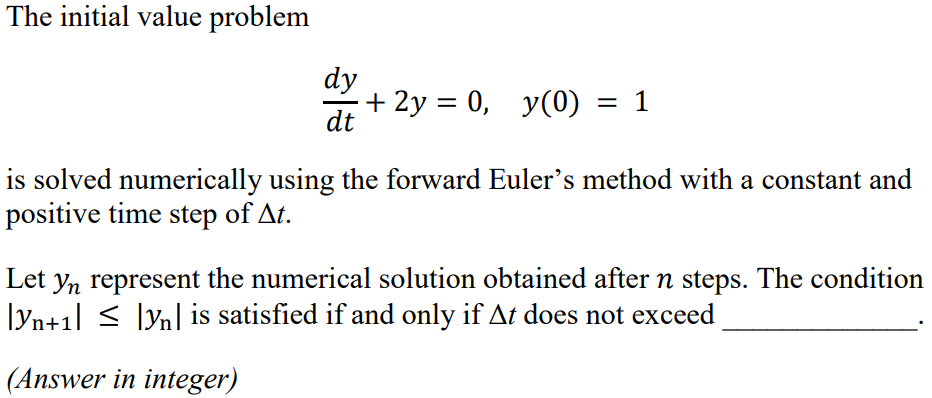
Correct Answer :
1
Solution :
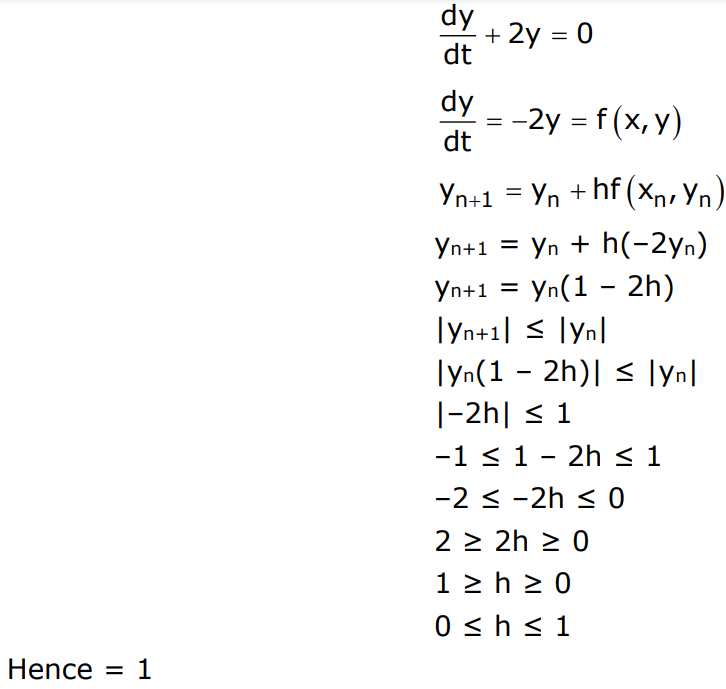
The correct answer is 1 (representing the maximum step size h for which the Euler's method is stable).
Step-by-Step Derivation and Explanation:
1. Identify the given differential equation:
We are given the first-order ordinary differential equation (ODE) shown in the image:
Rewriting it to express the derivative explicitly, we get:
2. Apply Euler's method:
The standard formula for Euler's forward method with step size h is:
Substituting into the equation:
Factoring out , we obtain:
3. Determine the stability criterion:
For the numerical solution to remain stable and not grow unboundedly as n increases, the magnitude of the solution at step n + 1 must not exceed that at step n:
Substituting the relation for gives:
Assuming , we divide both sides by :
4. Solve the inequality for step size h:
Unfolding the absolute value inequality yields:
Subtracting 1 from all parts of the inequality:
Multiplying by -1 and reversing the inequality signs:
Dividing by 2:
Which is equivalently written as:
Hence, the maximum step size for stability is 1.
Access expert-curated educational resources and study materials—completely free.
Create, conduct, and manage professional online assessments with Mindyard. Perfect for teachers and institutes.
Copyright © 2026 Mindyard. All Rights Reserved.