Correct Answer :
Solution :
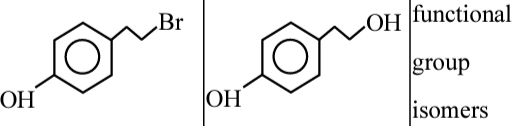
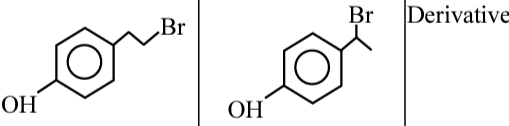
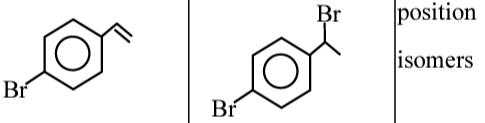
Correct Option: Option 3 (which shows B as 4-bromostyrene, C as 1-bromo-4-(1-bromoethyl)benzene, and states that A and C are position isomers).
Let us analyze the reaction sequence step-by-step:
Step 1: Identify Reactant A
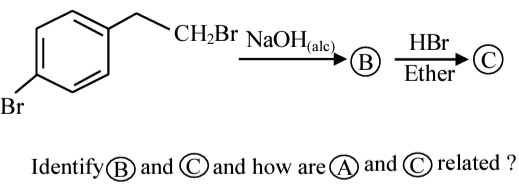
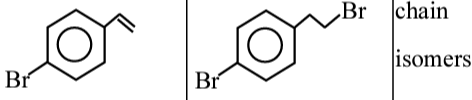
From the question image, the starting compound (Reactant A) is 1-bromo-4-(2-bromoethyl)benzene. It contains a benzene ring with a bromine atom () at the para-position and a 2-bromoethyl group () at the opposite position.
Step 2: Elimination Reaction to form B
When Reactant A is treated with alcoholic sodium hydroxide (), a strong base, it undergoes dehydrohalogenation (an E2 elimination reaction). The base abstracts a proton from the carbon beta to the leaving group on the side chain:
This elimination occurs on the alkyl side chain rather than the aromatic ring because aryl halides do not undergo elimination under these conditions. Thus, compound B is 4-bromostyrene (or 1-bromo-4-ethenylbenzene), which features a vinyl group () attached to the para-position of the bromobenzene ring.
Step 3: Hydrohalogenation Reaction to form C
When 4-bromostyrene (B) is treated with hydrobromic acid in ether (), it undergoes electrophilic addition across the carbon-carbon double bond. According to Markovnikov's rule, the electrophile () adds to the carbon with more hydrogen atoms (the terminal carbon) to generate the more stable carbocation intermediate:
This benzylic carbocation is highly resonance-stabilized by the aromatic ring. The nucleophile () then attacks the carbocation to form the major product:
Therefore, compound C is 1-bromo-4-(1-bromoethyl)benzene.
Step 4: Relationship between A and C
Let us compare the structures of compound A and compound C:
- Compound A: 1-bromo-4-(2-bromoethyl)benzene
- Compound C: 1-bromo-4-(1-bromoethyl)benzene
Both compounds share the same molecular formula () but differ in the position of the bromine atom along the ethyl chain (carbon 2 in A versus carbon 1 in C). Therefore, compounds A and C are position isomers.
Access expert-curated educational resources and study materials—completely free.
Create, conduct, and manage professional online assessments with Mindyard. Perfect for teachers and institutes.
Copyright © 2026 Mindyard. All Rights Reserved.