Correct Answer :
β⁺, α, β⁻
Solution :
The correct answer is β⁺, α, β⁻.
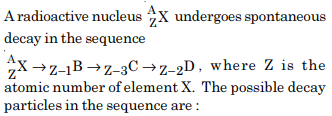
Based on the provided image, we have a radioactive nucleus X undergoing a series of spontaneous decays. We are given the following sequence of transformations for the atomic numbers:
To determine the decay particles, we must analyze the change in the atomic number (Z) at each step. Let's break down the sequence step-by-step:
Step 1: The nucleus goes from Z to Z - 1. A decrease in the atomic number by 1 indicates the emission of a positron (β⁺ particle). In β⁺ decay, a proton is converted into a neutron, reducing the atomic number by 1 while the mass number A remains unchanged.
Step 2: The nucleus transitions from Z - 1 to Z - 3. The atomic number decreases by 2. This is the hallmark of alpha (α) decay, in which an alpha particle (a helium nucleus with 2 protons and 2 neutrons) is emitted.
Step 3: Finally, the nucleus changes from Z - 3 to Z - 2. The atomic number increases by 1. This occurs during beta-minus (β⁻) decay, where a neutron is converted into a proton, emitting an electron (β⁻ particle).
Following these transformations, the sequence of emitted decay particles is β⁺, α, and β⁻.
Access expert-curated educational resources and study materials—completely free.
Create, conduct, and manage professional online assessments with Mindyard. Perfect for teachers and institutes.
Copyright © 2026 Mindyard. All Rights Reserved.