Options
Correct Answer :
Solution :
The correct option is:
Step-by-Step Explanation:
We are given two matrices, P and Q, visible in the question image:
Matrix P is a column matrix of size 3 × 1:
Matrix Q is a row matrix of size 1 × 3:
We need to determine the transpose of their product, which is represented as (PQ)'. There are two ways to solve this:
Method 1: Find the product PQ first, and then take its transpose
Since matrix P is of size 3 × 1 and matrix Q is of size 1 × 3, their product PQ will be a matrix of size 3 × 3.
Let us compute the product by multiplying each row of P with each column of Q:
Multiplying the elements:
- Row 1 of PQ:
[-1 × 2, -1 × (-4), -1 × 1] = [-2, 4, -1]
- Row 2 of PQ:
[2 × 2, 2 × (-4), 2 × 1] = [4, -8, 2]
- Row 3 of PQ:
[1 × 2, 1 × (-4), 1 × 1] = [2, -4, 1]
Thus, the product matrix PQ is:
Now, we find the transpose (PQ)' by exchanging rows and columns (the elements at row i, column j swap with row j, column i):
- First row of PQ [-2, 4, -1] becomes the first column of (PQ)'.
- Second row of PQ [4, -8, 2] becomes the second column of (PQ)'.
- Third row of PQ [2, -4, 1] becomes the third column of (PQ)'.
Applying this:
Method 2: Use the matrix transpose property (PQ)' = Q' P'
Let us first find the individual transposes of Q and P:
Since Q is a 1 × 3 row matrix, its transpose Q' is a 3 × 1 column matrix:
Since P is a 3 × 1 column matrix, its transpose P' is a 1 × 3 row matrix:
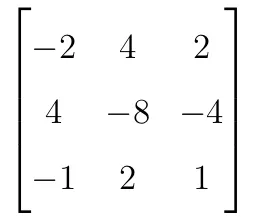
Now we compute the product Q' P':
Multiplying the terms:
- Row 1: [2 × (-1), 2 × 2, 2 × 1] = [-2, 4, 2]
- Row 2: [-4 × (-1), -4 × 2, -4 × 1] = [4, -8, -4]
- Row 3: [1 × (-1), 1 × 2, 1 × 1] = [-1, 2, 1]
This yields the exact same matrix:
Access expert-curated educational resources and study materials—completely free.
Create, conduct, and manage professional online assessments with Mindyard. Perfect for teachers and institutes.
Copyright © 2026 Mindyard. All Rights Reserved.