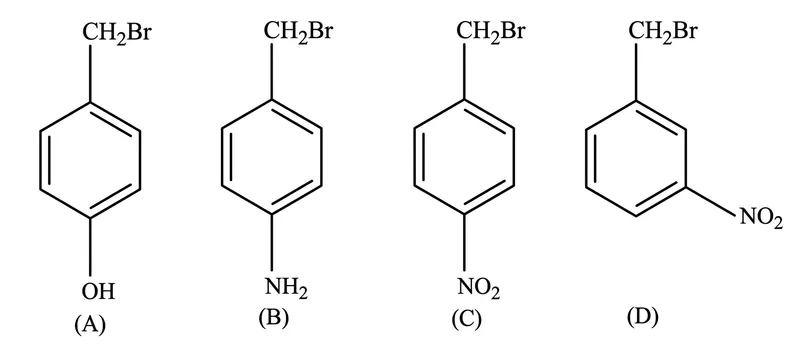
Rate of reaction of nucleophilic substitution in polar protic solvent is:
Correct Answer :
B > A > D > C
Solution :
Correct Option: B > A > D > C
Concept and Mechanism:
In a polar protic solvent, nucleophilic substitution for benzylic halides predominantly proceeds via the SN1 mechanism. The rate-determining step (RDS) in an SN1 reaction involves the ionization of the substrate to form a carbocation intermediate:
Therefore, the rate of nucleophilic substitution is directly proportional to the stability of the carbocation formed at the benzylic carbon.
Analyzing the Structures given in the image:
Upon cleavage of the C-Br bond, each compound forms a benzylic carbocation (Ar-CH2+) stabilized or destabilized by substituents attached to the benzene ring:
1. Structure (B) [p-amino benzyl bromide]: The para-NH2 group exerts a powerful +M (positive mesomeric/resonance) effect, donating lone pair electrons into the ring and strongly stabilizing the positive charge of the carbocation.
2. Structure (A) [p-hydroxy benzyl bromide]: The para-OH group also exerts a +M effect, but the +M power of -NH2 is greater than -OH because nitrogen is less electronegative than oxygen. Thus, carbocation stability from (B) is greater than (A).
3. Structure (D) [m-nitro benzyl bromide]: The -NO2 group is strongly electron-withdrawing. At the meta-position, it exerts a strong -I (inductive) effect without resonance destabilization at the benzylic position, making it less stable than (A) and (B), but more stable than (C).
4. Structure (C) [p-nitro benzyl bromide]: The -NO2 group at the para-position exerts both strong -M (mesomeric) and -I (inductive) effects, strongly destabilizing the positive charge on the benzylic carbon. Hence, it forms the least stable carbocation.
Order of Carbocation Stability (and Reaction Rate):
Hence, the correct decreasing order of the rate of nucleophilic substitution in a polar protic solvent is B > A > D > C.
Access expert-curated educational resources and study materials—completely free.
Create, conduct, and manage professional online assessments with Mindyard. Perfect for teachers and institutes.
Copyright © 2026 Mindyard. All Rights Reserved.