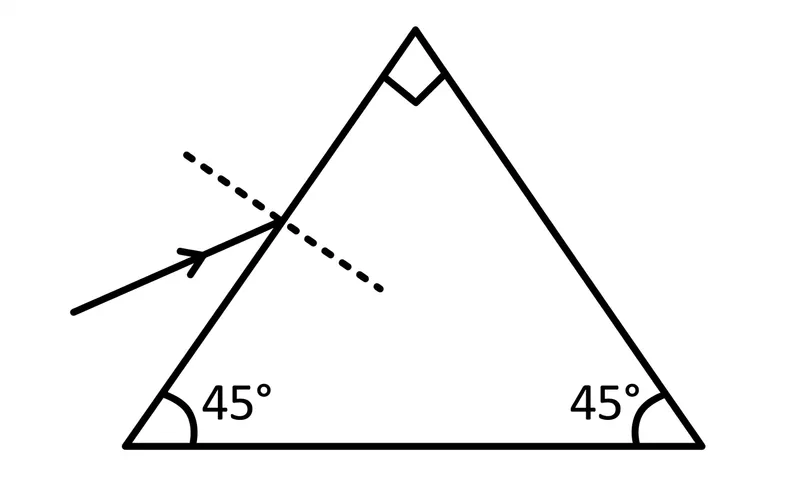
Refractive index of prism is √2. What should be angle of incidence for a light ray such that the emerging ray grazes out the surface.
Correct Answer :
90°
Solution :
The correct option is 90°.
Given Data:
Refractive index of the prism,
From the given image, the prism is a right-angled isosceles triangle with base angles of 45° and 45°, which means the angle of the prism is:
Step 1: Determine the critical angle ( or ) of the prism surface
When a light ray emerges grazing the second surface, the angle of emergence at the second surface is . Therefore, the angle of incidence at the second surface, , must be equal to the critical angle .
Using Snell's Law at the second surface:
Thus,
Step 2: Find the angle of refraction at the first surface ()
We know that for a prism, the apex angle is given by the relation:
Substituting the values of and :
So, the angle of refraction at the first surface is:
Step 3: Calculate the angle of incidence () at the first surface
Using Snell's Law at the first surface:
Substituting and :
Therefore, the required angle of incidence is:
Access expert-curated educational resources and study materials—completely free.
Create, conduct, and manage professional online assessments with Mindyard. Perfect for teachers and institutes.
Copyright © 2026 Mindyard. All Rights Reserved.