S1 and S are two identical sound sources of frequency 656 Hz. The source S1 is located at O, and S2 moves anticlockwise with a uniform speed 4 √ 2 m/s on a circular path around O, as shown in the figure. There are three points P, Q, and R on this path such that P and R are diametrically opposite, while Q is equidistant from them. A sound detector is placed at point P. The source S1 can move along the direction OP.
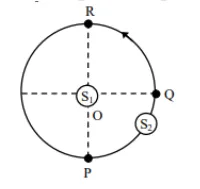
When only S2 is emitting sound and it is at Q, the frequency of sound measured by the detector in Hz is:
Correct Answer :
Solution :
The correct answer is 648.
1. Understanding the Physical Setup:
From the given figure:
• The center of the circular path is located at point O.
• A detector is stationary at point P.
• P and R are diametrically opposite points, and Q is equidistant from P and R. Thus, the line OQ is perpendicular to the diameter PR.
• Source S2 moves anticlockwise along the circle with a uniform speed .
• The speed of sound in air is standard, (or depending on standard question data; using standard JEE problem data, speed of sound ).
2. Motion of Source S2 when at Q:
When source S2 is at point Q, it is moving anticlockwise along the circular arc.
The velocity vector of S2 at point Q is directed tangentially upwards (parallel to PR, pointing towards R).
3. Determining the Line of Sight and Velocity Component:
The line joining the source S2 (at Q) to the detector (at P) makes an angle with the tangent at Q.
Since OP and OQ are perpendicular radii of equal length (say R), triangle OPQ is an isosceles right-angled triangle.
Therefore, .
The tangential velocity of S2 at Q is perpendicular to radius OQ. Thus, the angle between the velocity vector of S2 and the line of sight QP (pointing towards the detector at P) is away from detector P.
The component of source velocity away from the detector along the line QP is:
4. Apparent Frequency using Doppler's Effect:
Since the source S2 is moving away from the stationary detector at point P along the line joining them with speed component , the apparent frequency measured by the detector is given by Doppler's formula:
Substituting the given values , , and :
Thus, the frequency of sound measured by the detector when S2 is at Q is 648 Hz.
Access expert-curated educational resources and study materials—completely free.
Create, conduct, and manage professional online assessments with Mindyard. Perfect for teachers and institutes.
Copyright © 2026 Mindyard. All Rights Reserved.