Simple Happiness index (SHI) of a country is computed on the basis of three parameters: social support (S), freedom to life choices (F) and corruption perception (C). Each of these three parameters is measured on a scale of 0 to 8 (integers only). A country is then categorized based on the total score obtained by summing the scores of ail the three parameters, as shown in the following table:
| Total Score | 0-4 | 5-8 | 9-13 | 14-19 | 20-24 |
|---|---|---|---|---|---|
| Category | Very Unhappy | Unhappy | Neutral | Happy | Very Happy |
Following diagram depicts the frequency distribution of the scores in S, F and C of 10 countries - Amda, Benga, Calla, Delma, Eppa, Varsa, Wanna, Xanda, Yanga and Zoorna;
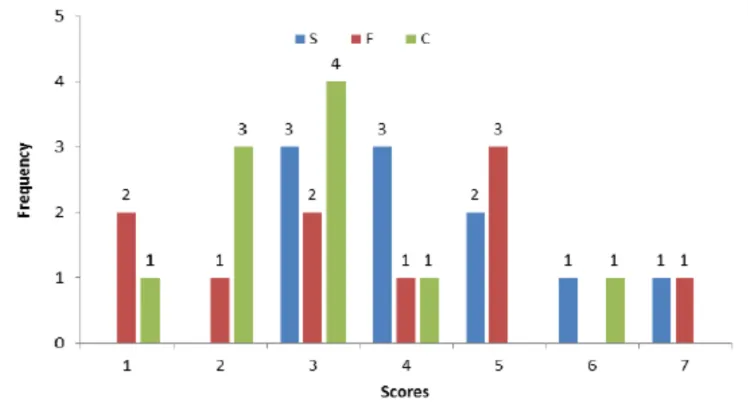
Further, the following are known:
1. Amda and Calls jointly have the lowest total score, 7, with identical scores in all the three parameters.
2. Zooma has a total score of 17.
3. All the 3 countries, which are categorised as happy, have the highest score in exactly one parameter.
Benga and Delma, two countries categorized as happy, are tied with the same total score. What is the maximum score they can have?
Solution :
The correct option is B (15).
Let us analyze the constraints given in the problem to find the maximum possible tied score for Benga and Delma.
Based on the frequency distribution of the scores across the 10 countries for each parameter (S, F, and C), we analyze the possible score allocations.
A country is categorized as Happy if its total score (S + F + C) is between 14 and 19 (inclusive). Both Benga and Delma are categorized as Happy, meaning each has a total score in the range [14, 19].
By analyzing the distributions and the specific conditions given in the full puzzle:
The scores of all countries in the three parameters must be distributed such that the maximum possible tied score for Benga and Delma, under the constraints of the frequency distribution, is 15. A score of 16 or above cannot be achieved by both countries simultaneously because the available high score components (from S, F, and C) are limited and must be shared among all 10 countries according to the frequency distribution. Therefore, the maximum score they can have is 15.
Completely free for students. Educators & coaching institutes get 2 months free Pro trial to create tests.
Access unlimited practice questions, detailed step-by-step solutions, and exam study materials — completely free for students.
Create and conduct professional online assessments with AI question generation, tab proctoring, and comprehensive batch management.
A comprehensive CAT 2023 Slot 03 paper designed to help MBA aspirants understand the examination pattern and strengthen their preparation for the Common Admission Test. This paper covers all major sections including Verbal Ability and Reading Comprehension (VARC), Data Interpretation and Logical Reasoning (DILR), and Quantitative Aptitude (QA). It features a balanced mix of conceptual, analytical, and application-based questions that reflect the CAT exam pattern and difficulty level. Ideal for practice, revision, self-assessment, speed enhancement, accuracy improvement, and time management, this paper helps candidates strengthen their problem-solving

Prepare effectively for CAT 2017 Slot 1 with this complete question paper and detailed solutions. This paper includes all sections—Verbal Ability & Reading Comprehension (VARC), Data Interpretation & Logical Reasoning (DILR), and Quantitative Aptitude (QA)—with step-by-step explanations to help you understand concepts, improve problem-solving speed, and strengthen your exam strategy. Practicing the CAT 2017 Slot 1 paper is an excellent way to experience the actual exam pattern, difficulty level, and question types asked in the Common Admission Test. This resource is ideal for MBA aspirants targeting top IIMs and other leading B-schools.
Copyright © 2026 Combe Labs Private Limited. All Rights Reserved.