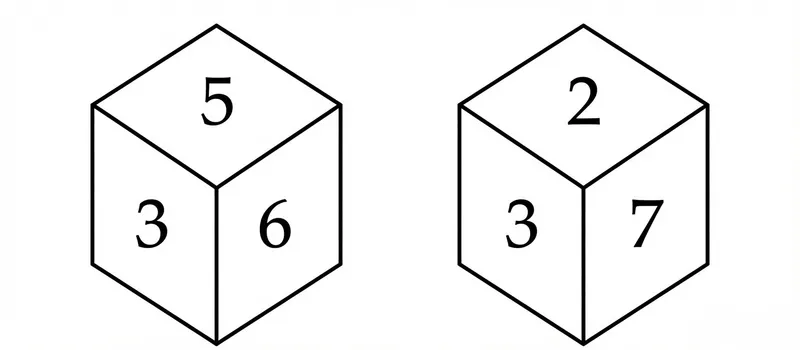
Six numbers 5, 3, 6, 7, 9 and 2 are written on different faces of a dice. Two positions of this dice are shown in the figure below. Find the number on the face opposite to the one having 5.
Correct Answer :
2
Solution :
The correct answer is 2.
To find the number on the face opposite to the one having 5, we can analyze the two positions of the dice shown in the image:
1. First Position: The visible faces show 5 on the top, 3 on the front-left, and 6 on the front-right.
2. Second Position: The visible faces show 2 on the top, 3 on the front-left, and 7 on the front-right.
Step-by-Step Analysis:
1. Identify the common face: The face with the number 3 is at the front-left position in both views of the dice.
2. Find the faces adjacent to 3:
From the first position, we see that 5 and 6 are adjacent to 3.
From the second position, we see that 2 and 7 are adjacent to 3.
Therefore, the faces adjacent to 3 are 2, 5, 6, and 7.
3. Determine the face opposite to 3:
Since a dice has six faces containing the numbers 5, 3, 6, 7, 9, and 2, the only face not adjacent to 3 is 9. Thus, the face opposite to 3 must be 9.
4. Find the face opposite to 5:
Let us consider the circular order of the four faces adjacent to 3 (which are 5, 6, 2, and 7) by rotating the dice around the axis of face 3:
In the first position, 5 is on the top and 6 is on the right of 3.
In the second position, 2 is on the top and 7 is on the right of 3.
To keep the orientation consistent when rotating around face 3, the circular sequence of the adjacent faces must be 5 → 6 → 2 → 7 → 5.
In this circular arrangement of four faces, the faces opposite to each other are separated by one face:
- The face opposite to 5 is 2.
- The face opposite to 6 is 7.
Thus, the number on the face opposite to 5 is 2.
Access expert-curated educational resources and study materials—completely free.
Create, conduct, and manage professional online assessments with Mindyard. Perfect for teachers and institutes.
Copyright © 2026 Mindyard. All Rights Reserved.