Source traits are:
(A) stable
(B) result of the interaction between surface traits
(C) considered as the building blocks of personality
(D) quite generalised dispositions
Choose the correct answer from the options given below:
Solution :
The correct answer is (A) and (C) only.
Explanation:
In trait theory, particularly in Raymond Cattell's theory of personality, traits are categorized into two main types: surface traits and source traits.
1. Understanding Source Traits:
Source traits are the underlying, basic structures of personality. They are not directly observable but are inferred through statistical analysis (factor analysis) of surface traits. These traits are highly stable over time and across different situations, acting as the fundamental building blocks of an individual's personality.
- Statement (A) is correct because source traits are stable characteristics of personality.
- Statement (C) is correct because source traits are considered the basic building blocks of personality, giving rise to the observable surface traits.
2. Why other options are incorrect:
- Statement (B) is incorrect because source traits are the cause of surface traits, not the result of their interaction.
- Statement (D) is incorrect because "quite generalised dispositions" is a description more aligned with Gordon Allport's definition of common traits or central/cardinal dispositions, rather than Cattell's specific definition of source traits.
Therefore, only statements (A) and (C) accurately describe source traits, making "(A) and (C) only" the correct option.
Completely free for students. Educators & coaching institutes get 2 months free Pro trial to create tests.
Access unlimited practice questions, detailed step-by-step solutions, and exam study materials — completely free for students.
Create and conduct professional online assessments with AI question generation, tab proctoring, and comprehensive batch management.
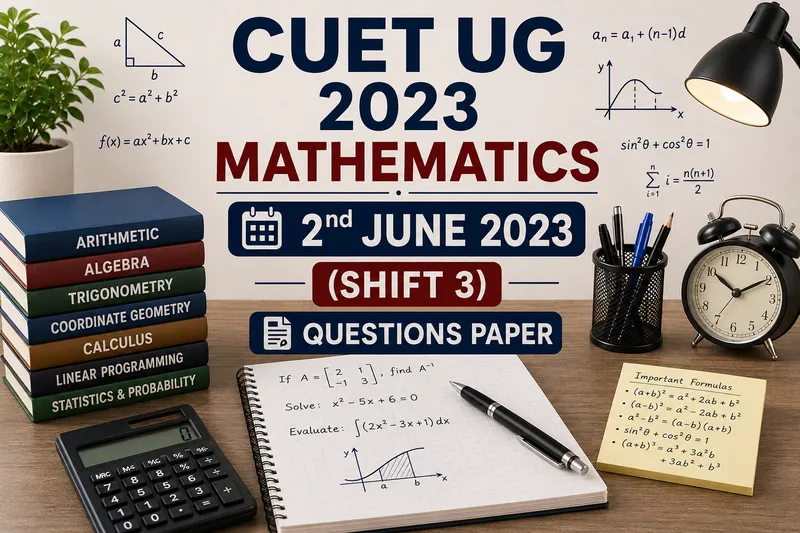
A comprehensive CUET UG Mathematics Question Paper with Solutions – 2 June 2023 (Shift 3) designed to help students practice and understand the actual CUET exam pattern. This paper covers important topics from Algebra, Calculus, Coordinate Geometry, Probability, Statistics, Matrices, Determinants, and Vectors, featuring a balanced mix of conceptual, numerical, and application-based questions. Detailed solutions are provided to strengthen problem-solving skills, improve conceptual clarity, and enhance calculation accuracy. Based on the CUET syllabus and previous year exam trends, this paper is ideal for practice, revision, self-assessment, time management, previous year analysis, and final preparation for upcoming CUET UG Mathematics examinations.
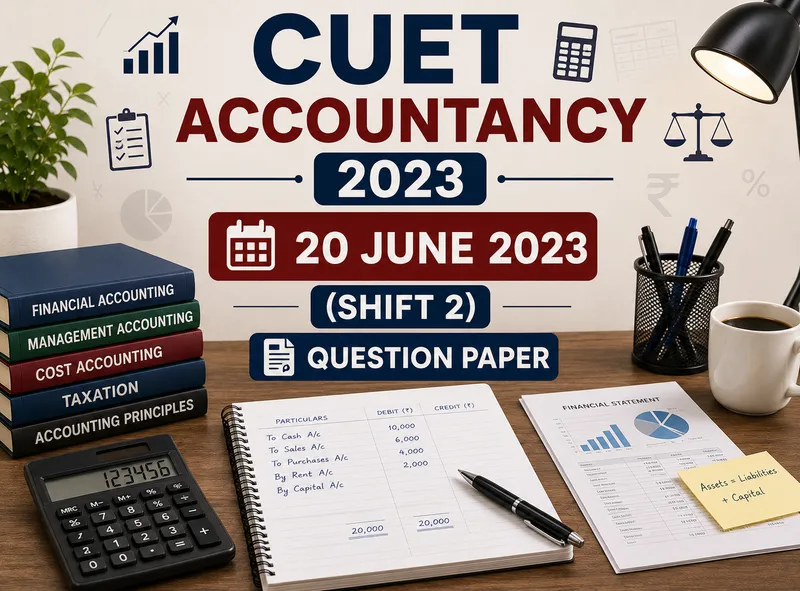
A comprehensive CUET Accountancy Question Paper – 20 June 2023 (Shift 2) designed to help students practice and analyze previous year exam patterns for effective CUET preparation. This paper covers important topics including Accounting for Partnership Firms, Company Accounts, Financial Statements Analysis, Cash Flow Statements, Accounting Ratios, and Fundamental Accounting Principles. It features a balanced mix of conceptual, numerical, and application-based questions to strengthen accounting concepts, improve calculation accuracy, and enhance problem-solving skills. Based on the CUET exam structure and syllabus, this paper is ideal for practice, revision, self-assessment, time management, previous year analysis, and final preparation for upcoming CUET Accountancy examinations.
Copyright © 2026 Combe Labs Private Limited. All Rights Reserved.