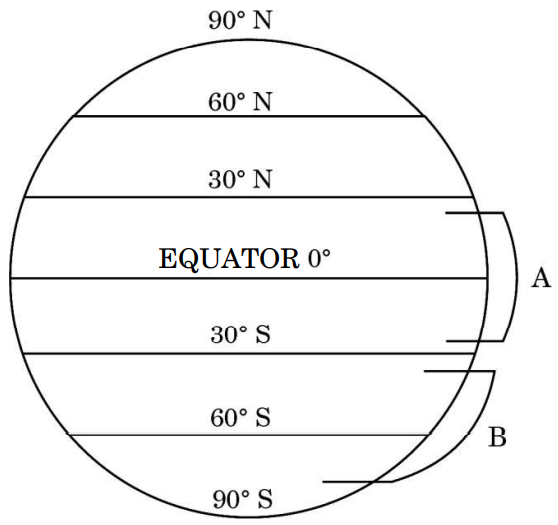
Study the diagrammatic representation given below of the Earth with regions marked 'A' and 'B' respectively. Answer the questions that follow.
(a) Write the observations made regarding the species diversity when moving from region 'A' to region 'B'. Give two reasons also.
(b) Stating the reason, mention the approximate number of bird species recorded in India.
or
(b) Name the region in the world that records the greatest biodiversity and mention why.
Correct Answer :
(a) Species diversity decreases as we move from region A to region B. Reasons : less Constant mean annual temperature, lesser habitable land area, availability of lesser solar energy, lesser productivity, any other correct reason in ‘B’ region.
(b) More the 1200 species of birds, Indian land mass being largely in the tropical latitudes.
or
(b) Amazonian rainforest (in South America), mainly being in tropical region.
Solution :
Correct Answer:
(a) Species diversity decreases as we move from region A to region B.
Reasons: Less constant mean annual temperature, lesser habitable land area, availability of lesser solar energy, and lesser productivity in region B.
(b) India has more than 1200 species of birds because the Indian landmass is located largely within the tropical latitudes.
OR
(b) The Amazonian rainforest (in South America) records the greatest biodiversity because it is located mainly in the tropical region.
Explanation:
Analysis of the Diagram:
The provided diagram represents the Earth with latitude markings:
• The Equator is marked at
• Northern latitudes are labeled up to
• Southern latitudes are labeled down to
• Region A is bracketed between
and
,
which represents the tropical region.
• Region B is bracketed between
and
,
which represents the temperate and polar zones of the Southern Hemisphere.
Part (a): Species Diversity Gradient
As we move from region A (tropics) to region B (temperate/polar region), the species diversity decreases significantly. This latitudinal gradient in biodiversity occurs due to the following key reasons:
1. Temperature Stability: Tropical regions (A) have a relatively constant, predictable, and warm mean annual temperature, which promotes niche specialization. In contrast, temperate/polar regions (B) experience extreme seasonal temperature variations, making them less hospitable for diverse species.
2. Solar Energy and Productivity: Region A receives direct solar radiation throughout the year, whereas region B receives lesser solar energy. Higher solar energy in the tropics leads to higher primary productivity, which indirectly supports a greater number of species and complex food webs.
3. Habitable Land and Speciation Time: The tropical latitudes have remained relatively undisturbed by glaciations over millions of years, allowing species more time to evolve and diversify, whereas temperate regions have faced historical glaciations that reduced habitable area and reset biodiversity progress.
Part (b): Bird Species in India
India is home to more than 1200 species of birds. This high richness of avian species is primarily because the major portion of the Indian landmass lies within the tropical latitudes. Tropical environments offer abundant food resources, favorable nesting conditions, and stable climates year-round, which support high species diversity compared to temperate regions.
OR
Alternative Part (b): Region with the Greatest Biodiversity
The Amazonian rainforest in South America records the greatest biodiversity on Earth. This is because it is situated mainly in the tropical region. The tropical climate provides continuous warmth, high humidity, abundant rainfall, and high solar energy. These factors lead to extremely high primary productivity, creating diverse ecological niches that support millions of species of plants, insects, birds, mammals, and other organisms.
Access expert-curated educational resources and study materials—completely free.
Create, conduct, and manage professional online assessments with Mindyard. Perfect for teachers and institutes.
Copyright © 2026 Mindyard. All Rights Reserved.
 Set - 3-1782888548748.webp)