Study the diagrammatic representation given below of the Earth with regions marked 'A' and 'B' respectively, Answer the following questions.
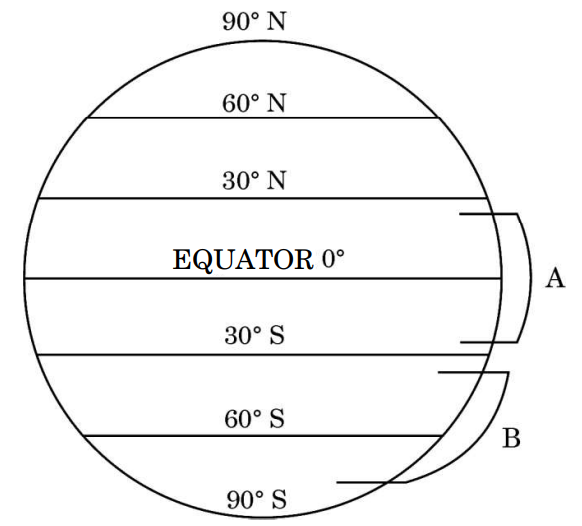
(a) Write the observations made regarding the species diversity when moving from region 'A' to region 'B'. Give two reasons also.
(b) Stating the reason, mention the approximate number of bird species recorded in India.
or
(b) Name the region in the world that records the greatest biodiversity and mention why.
Correct Answer :
(a) Species diversity decreases as we move from region A to region B. Reasons : less Constant mean annual temperature, lesser habitable land area, availability of lesser solar energy, lesser productivity, any other correct reason in ‘B’ region.
(b) More the 1200 species of birds, Indian land mass being largely in the tropical latitudes.
or
(b) Amazonian rainforest (in South America), mainly being in tropical region.
Solution :
Correct Answer / Solution:
(a) Observation and Reasons for Species Diversity from Region A to Region B:
• Observation: Species diversity decreases as we move from region A to region B (from lower latitudes/tropics to higher latitudes/polar regions).
• Reasons (any two):
1. Climate Stability: Tropical regions (region A) have a relatively constant, predictable, and stable mean annual temperature compared to temperate and polar regions (region B), which are highly seasonal and subject to harsher climates.
2. Solar Energy and Productivity: Region A receives more direct solar energy, leading to higher primary productivity, which indirectly supports a greater number of niches and species. In contrast, region B has lower availability of solar energy and lower productivity.
3. Habitable Land Area: Region B has lesser habitable land area under favorable climatic conditions compared to region A.
(b) Bird Species in India:
India records more than 1200 species of birds. The primary reason for this high diversity is that a major portion of the Indian landmass lies in the tropical latitudes (corresponding to the biodiversity-rich region A), which provides favorable climatic conditions, stable temperatures, and high resources year-round.
OR
(b) Region with the Greatest Biodiversity:
The region in the world that records the greatest biodiversity is the Amazonian rainforest (located in South America). This is because it is situated mainly in the tropical region close to the equator, benefiting from maximum solar radiation, high moisture levels, stable temperatures, and a long undisturbed evolutionary history free from frequent glaciations.
Step-by-Step Educational Explanation:
1. Analyzing the Diagram:
By studying the diagrammatic representation of Earth:
• The line labeled EQUATOR 0° marks the middle of the globe.
• The brackets define two distinct zones. Region 'A' is located close to the equator, spanning between 30° N and 30° S latitude lines. This is the tropical zone.
• Region 'B' lies at higher latitudes, extending from 30° S down to the South Pole at 90° S. This represents the temperate and polar zones.
2. Understanding Latitudinal Gradients of Biodiversity (Part a):
Ecology shows that biodiversity is not uniformly distributed across the globe but follows a latitudinal gradient. As we travel away from the equator (region A) toward the poles (region B), the number of species drops significantly. This latitudinal gradient is driven by three main factors:
• Speciation and Time: Tropical latitudes have remained relatively undisturbed for millions of years, allowing species to evolve continuously. Temperate regions, on the other hand, have experienced frequent glaciations in the past.
• Environmental Constancy: Tropical environments are less seasonal, more constant, and predictable. Such environments promote niche specialization and lead to greater species diversity.
• Solar Radiation: The tropics receive more solar energy, which translates to high photosynthetic productivity, supporting complex food webs.
3. Analyzing India's Bird Diversity (Part b - First Option):
India has a rich avian fauna with more than 1200 species of birds. Even though India's landmass is relatively small compared to polar continents, its geographical location mostly within the tropical belt (closer to region A than region B) allows it to sustain tropical forest ecosystems that support high species richness.
4. Analyzing the Amazon Rainforest (Part b - Second Option):
The Amazonian rainforest in South America hosts the most diverse terrestrial biome on Earth, containing millions of species of plants, insects, birds, mammals, and amphibians. Its equatorial tropical location ensures continuous warm temperatures, high rainfall, and maximum solar input, which are the ideal conditions for supporting vast biological diversity.
Access expert-curated educational resources and study materials—completely free.
Create, conduct, and manage professional online assessments with Mindyard. Perfect for teachers and institutes.
Copyright © 2026 Mindyard. All Rights Reserved.
 Set - 3-1782888548748.webp)