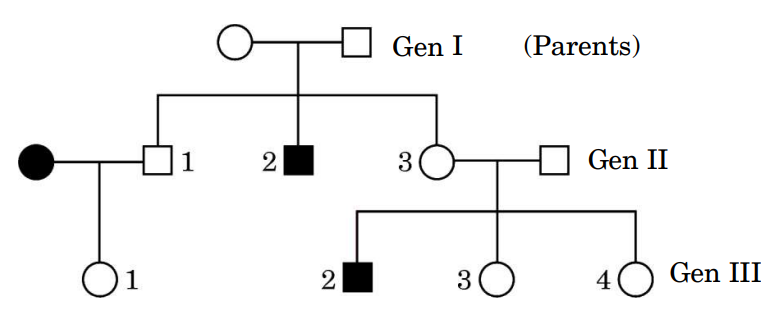
Study the given pedigree chart and answer the questions that follow.
(a) Is the trait given in the chart dominant or recessive ? Give reason in support of your answer.
(b) Is this trait autosomal or sex-linked ? Give reason in support of your answer.
(c) Write the possible genotypes of the children numbers the second generation.
Correct Answer :
(a) Recessive trait, both the parents in generation I do not express the trait yet it appears in the progeny.
(b) Autosomal trait, both male and females have equal chances of getting the trait.
(c) Child ‘1’ : Aa/AA , Child ‘3’ : Aa
or
(a) Recessive trait, both the parents in generation I do not express the trait, yet it appears in the progeny.
(b) Sex linked trait, comparatively more male are getting affected.
(c) Child ‘1’ : XY, Child ‘3’: X’ X(carrier)
Solution :
Correct Answer:
(a) Recessive trait, both the parents in generation I do not express the trait yet it appears in the progeny.
(b) Autosomal trait, both male and females have equal chances of getting the trait.
(c) Child ‘1’ : Aa/AA , Child ‘3’ : Aa
or
(a) Recessive trait, both the parents in generation I do not express the trait, yet it appears in the progeny.
(b) Sex linked trait, comparatively more male are getting affected.
(c) Child ‘1’ : XY, Child ‘3’: X’ X(carrier)
Detailed Step-by-Step Explanation:
Part (a): Dominant vs. Recessive Trait
1. In a pedigree chart, if a trait is dominant, it typically appears in every generation, and every affected individual must have at least one affected parent.
2. Looking at the provided pedigree chart, the parents in generation I (labeled Gen I (Parents)) are represented by an unfilled circle (mother) and an unfilled square (father), meaning they are both unaffected.
3. However, their second child in the second generation (labeled 2 under Gen II) is represented by a filled black square, indicating an affected male progeny.
4. Similarly, child 3 (unaffected female) in Gen II and her unaffected partner have an affected son (labeled 2 in Gen III).
5. Since the trait skips generations and appears in the offspring of unaffected parents, the trait is recessive.
Part (b): Autosomal vs. Sex-Linked Trait
Pedigree charts can often be interpreted through multiple genetic hypotheses depending on the frequency and transmission patterns:
Interpretation 1: Autosomal Trait
If the trait is autosomal, the gene is located on one of the non-sex chromosomes. This means males and females inherit the allele and express the phenotype with equal probability. In the pedigree, we see the trait appearing in males (Gen II-2 and Gen III-2) and the partner of Gen II-1 is an affected female, showing that both sexes can be affected.
Interpretation 2: Sex-Linked Trait
If the trait is sex-linked (specifically X-linked recessive), males are hemizygous (having only one X chromosome) and will express the trait if they inherit a single copy of the recessive allele from their mother. In this chart, the affected descendants are exclusively male (Gen II-2 and Gen III-2), supporting the observation that comparatively more males are affected.
Part (c): Genotypes of Children in the Second Generation (Gen II)
Let us determine the genotypes under both autosomal and sex-linked recessive assumptions:
Under the Autosomal Recessive Model (Alleles: A = Normal, a = Affected):
• Since the parents in Gen I are unaffected but have an affected son (Gen II-2 with genotype aa), both parents must be carriers (genotype Aa).
• Child ‘1’ (Gen II-1): He is an unaffected male. His parents are Aa × Aa, so he can be either homozygous dominant (AA) or a heterozygous carrier (Aa).
• Child ‘3’ (Gen II-3): She is an unaffected female. She marries an unaffected male and has an affected son (Gen III-2 with genotype aa). Since the son must inherit one recessive allele a from each parent, Child ‘3’ must be a carrier with the genotype Aa.
Under the Sex-Linked Recessive Model (Alleles: X = Normal, X’ = Affected, Y = Y chromosome):
• The father in Gen I is unaffected (XY). The mother in Gen I is unaffected but has an affected son (Gen II-2 with genotype X’Y), so the mother must be a carrier (X’X).
• Child ‘1’ (Gen II-1): He is an unaffected male. He inherits his Y chromosome from his father and his normal X chromosome from his mother, resulting in the genotype XY.
• Child ‘3’ (Gen II-3): She is an unaffected female. She marries an unaffected male (XY) and has an affected son (Gen III-2 with genotype X’Y). Since the son inherits his Y chromosome from his father, he must have inherited his affected X chromosome (X’) from his mother. Thus, Child ‘3’ must be a carrier with the genotype X’X.
Access expert-curated educational resources and study materials—completely free.
Create, conduct, and manage professional online assessments with Mindyard. Perfect for teachers and institutes.
Copyright © 2026 Mindyard. All Rights Reserved.
 Set - 3-1782888548748.webp)