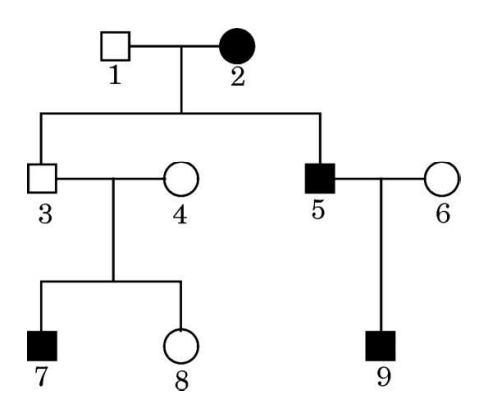
Study the pedigree chart given below and answer the questions that follow :
(i) Is this trait recessive or dominant ? Give reason.
(ii) Is this trait sex-linked or autosomal ? Give reason.
(iii) Among individuals 3, 4 and 7, which one is homozygous for the trait ?
Correct Answer :
(i)
• Recessive Trait
• Individual 3 and 4 both do not suffer from the disease but have passed it to their offspring individual no. 7/ Unaffected parents of individual 7 have transmitted the trait to him.
(ii)
• Autosomal
• Both the sexes have equal chance having the trait.
(iii) Individual 7 is – homozygous.
Solution :
Correct Answer:
(i) Recessive Trait. Reason: Individuals 3 and 4 do not suffer from the disease but have passed it to their offspring, individual 7 (unaffected parents of individual 7 have transmitted the trait to him).
(ii) Autosomal Trait. Reason: Both sexes have an equal chance of inheriting and expressing the trait.
(iii) Individual 7 is homozygous for the trait.
Step-by-Step Explanation:
1. Analysis of the Pedigree Chart Symbols:
Based on the provided pedigree chart, we can identify the following components:
• Squares represent males (individuals 1, 3, 5, 7, and 9).
• Circles represent females (individuals 2, 4, 6, and 8).
• Shaded shapes represent affected individuals expressing the trait (individuals 2, 5, 7, and 9).
• Unshaded shapes represent unaffected individuals (individuals 1, 3, 4, 6, and 8).
2. Determining if the Trait is Recessive or Dominant:
To determine the nature of the allele causing the trait:
• Look at parent individuals 3 (unaffected male) and 4 (unaffected female). Neither of these parents shows the disease phenotype.
• However, they have an offspring, individual 7 (affected male), who displays the trait.
• A dominant trait cannot skip generations because any individual carrying the dominant allele would express it. Since unaffected parents (3 and 4) have produced an affected offspring (7), the trait must be recessive, and the parents must be unaffected carriers who passed the recessive alleles to their offspring.
3. Determining if the Trait is Autosomal or Sex-Linked:
• The pedigree shows that the trait is present in both females (individual 2) and males (individuals 5, 7, and 9).
• The trait is transmitted from an affected mother (2) to her son (5), and also appears in a male child (7) from unaffected parents (3 and 4).
• Because both males and females are affected, there is no sex-specific bias in transmission, showing that both sexes have an equal chance of inheriting and expressing the trait. Thus, it is an autosomal trait.
4. Determining Which Individual (3, 4, or 7) is Homozygous:
Let us represent the dominant normal allele as and the recessive disease allele as .
• For an individual to express an autosomal recessive trait, they must possess two copies of the recessive allele, giving them a genotype of:
Since individual 7 is affected, his genotype must be homozygous recessive ().
• Individuals 3 and 4 are unaffected but must have contributed one recessive allele each to individual 7. Therefore, their genotypes must be heterozygous:
• Consequently, among individuals 3, 4, and 7, individual 7 is the one who is homozygous for the trait.
Access expert-curated educational resources and study materials—completely free.
Create, conduct, and manage professional online assessments with Mindyard. Perfect for teachers and institutes.
Copyright © 2026 Mindyard. All Rights Reserved.
 Set - 3-1782888548748.webp)