Ten moles of an ideal monoatomic gas, initially in state a at atmospheric pressure and temperature Ta = 27°C, is enclosed in a metal cylinder of volume V0 fitted with a frictionless piston. The gas is suddenly compressed to state b with volume V0/3. Now, keeping the piston stationary, the cylinder is submerged in a water bath of temperature 11°C until the gas reaches the temperature of the water bath, which is denoted as state c. Finally, while still in the water bath, the piston is brought slowly to its initial position, which is denoted as state f. If R is universal gas constant, then the correct option(s) is/are:
Given: 91/3 = 2.08
Options
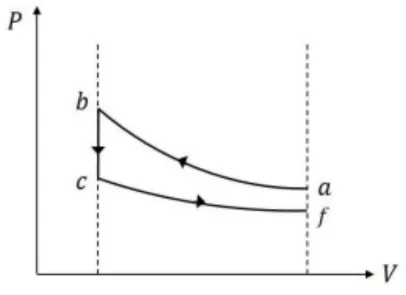
The schematic P-V diagram of the processes described above is:
The change in internal energy in going from state a to b is 4860R.
The net change in the internal energy in the whole process is -240R.
The pressure and temperature of the state b are 2.08 times the atmospheric pressure and 624 K, respectively.
Correct Answer :
The schematic P-V diagram of the processes described above is:
The change in internal energy in going from state a to b is 4860R.
The net change in the internal energy in the whole process is -240R.
Solution :
The correct options are:
1. The schematic P-V diagram of the processes described above is:
2. The change in internal energy in going from state a to b is 4860R.
3. The net change in the internal energy in the whole process is -240R.
Step-by-Step Explanation:
Given Data:
Number of moles of monoatomic gas, n = 10
Initial state (a): Pressure Pa = P0 (1 atm), Temperature Ta = 27°C = 300 K, Volume Va = V0
For a monoatomic ideal gas, degrees of freedom f = 3, so its molar specific heat at constant volume is Cv = (3/2)R, and the adiabatic index is γ = Cp/Cv = 5/3.
Process 1: Sudden compression from state a to state b
Since the gas is compressed suddenly, no heat exchange occurs during this step, making process a → b adiabatic.
Volume at state b is Vb = V0/3.
Using the adiabatic relation between temperature and volume, T Vγ-1 = constant:
Using 32/3 = (9)1/3 = 2.08:
Now, let's calculate the change in internal energy (ΔUa→b) from state a to b:
Thus, the change in internal energy from state a to state b is indeed 4860R.
Process 2: Cooling at constant volume from state b to state c
The piston is kept stationary, so the volume remains constant at Vc = V0/3 (Isochoric process).
The cylinder is submerged in a water bath of temperature Tc = 11°C = 284 K until thermal equilibrium is established.
Process 3: Slow expansion from state c to state f
While remaining in the water bath, the piston is brought back slowly to its initial position Vf = V0. Since the process is carried out slowly in a constant temperature water bath, process c → f is isothermal at Tf = Tc = 284 K.
Net Change in Internal Energy for the Whole Process (a → b → c → f):
The initial temperature of the gas is Ta = 300 K and the final temperature of the gas is Tf = 284 K.
Since internal energy of an ideal gas depends only on temperature:
Thus, the net change in internal energy across the whole process is -240R.
Analysis of the P-V Diagram:
1. a → b: Adiabatic compression where volume decreases from V0 to V0/3, and pressure increases steeply along an adiabatic curve.
2. b → c: Isochoric cooling at volume V0/3, shown as a vertical downward line as pressure decreases due to cooling from 624 K to 284 K.
3. c → f: Isothermal expansion back to volume V0 along an isotherm corresponding to 284 K.
This matches the provided P-V curve diagram perfectly.
Access expert-curated educational resources and study materials—completely free.
Create, conduct, and manage professional online assessments with Mindyard. Perfect for teachers and institutes.
Copyright © 2026 Mindyard. All Rights Reserved.