
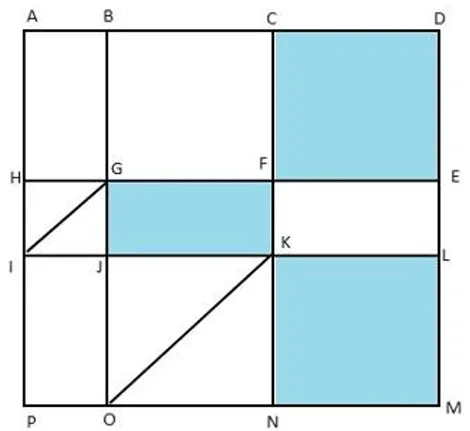
The above is a schematic diagram of walkways (indicated by all the straight-lines) and lakes (3 of them, each in the shape of rectangles– shaded in the diagram) of a gated area. Different points on the walkway are indicated by letters (A through P) with distances being OP = 150 m, ON = MN = 300 m, ML = 400 m, EL = 200 m, DE = 400 m. The following additional information about the facilities in the area is known. 1. The only entry/exit point is at C. 2. There are many residences within the gated area; all of them are located on the path AH and ML with four of them being at A, H, M, and L. 3. The post office is located at P and the bank is located at B.
One person enters the gated area and decides to walk as much as possible before leaving the area without walking along any path more than once and always walking next to one of the lakes. Note that he may cross a point multiple times. How much distance (in m) will he walk within the gated area?
Solution :
The correct answer is 3800.
Step 1: Understand the Layout and Identify the Lakes
Based on the provided schematic diagram, the area consists of three shaded rectangular lakes:
1. Lake 1 (Top-Right): Bounded by the vertices , , , and .
2. Lake 2 (Middle): Bounded by the vertices , , , and .
3. Lake 3 (Bottom-Right): Bounded by the vertices , , , and .
Step 2: Determine the Dimensions of the Walkway Segments
We are given the following distances from the question text:
- Horizontal segments:
Since the walkways form a rectangular grid, we can deduce:
- Vertical segments:
(so )
(so and )
Step 3: Identify the Eligible Walkway Paths
The person must start at the entry point , walk along the paths without repeating any path, and always walk next to one of the lakes (i.e., on the boundary paths of the three lakes).
Let us calculate the perimeter (loop length) of each lake:
- Lake 1 Loop (C-D-E-F-C):
- Lake 2 Loop (F-G-J-K-F):
- Lake 3 Loop (K-L-M-N-K):
Step 4: Check if an Eulerian Circuit Exists
The lakes are connected at point (connecting Lake 1 and Lake 2) and point (connecting Lake 2 and Lake 3).
Let's find the degree (number of connected walkway segments) of each vertex in the combined boundary graph:
- Vertices , , , , , , , each have a degree of 2.
- Vertices and each have a degree of 4.
Since all vertices have an even degree and the graph is connected, an Eulerian circuit exists. This means a person starting at the entry point can walk through every single one of these boundary segments exactly once and return to the exit point .
Step 5: Calculate the Total Distance Walked
Summing the perimeters of the three loops gives:
Completely free for students. Educators & coaching institutes get 2 months free Pro trial to create tests.
Access unlimited practice questions, detailed step-by-step solutions, and exam study materials — completely free for students.
Create and conduct professional online assessments with AI question generation, tab proctoring, and comprehensive batch management.

Practice the complete CLAT 2015 UG Question Paper to improve your preparation for the Common Law Admission Test. This previous year paper covers the key sections of CLAT UG, including English, General Knowledge & Current Affairs, Elementary Mathematics, Legal Aptitude, and Logical Reasoning. Solve CLAT 2015 UG questions to understand the previous year exam pattern, practice important concepts, improve accuracy and speed, and prepare effectively for law entrance examinations.

Prepare for CLAT 2019 UG with the complete question paper and solutions. This paper covers all major sections of the Common Law Admission Test (CLAT) Undergraduate exam, including English Language, Current Affairs & General Knowledge, Legal Reasoning, Logical Reasoning, and Quantitative Techniques.Use the CLAT 2019 UG question paper to practice exam-level questions, understand the question pattern, improve time management, and strengthen your preparation for law entrance examinations.
Copyright © 2026 Combe Labs Private Limited. All Rights Reserved.


