
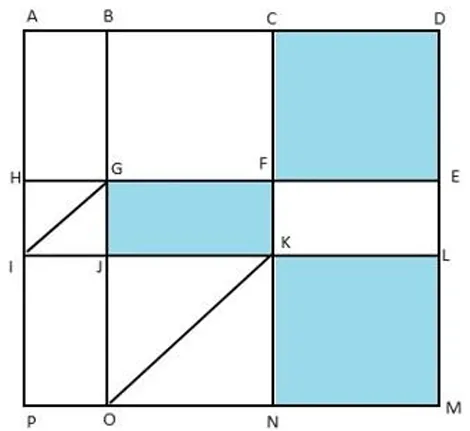
The above is a schematic diagram of walkways (indicated by all the straight-lines) and lakes (3 of them, each in the shape of rectangles– shaded in the diagram) of a gated area. Different points on the walkway are indicated by letters (A through P) with distances being OP = 150 m, ON = MN = 300 m, ML = 400 m, EL = 200 m, DE = 400 m. The following additional information about the facilities in the area is known. 1. The only entry/exit point is at C. 2. There are many residences within the gated area; all of them are located on the path AH and ML with four of them being at A, H, M, and L. 3. The post office is located at P and the bank is located at B.
Visitors coming for morning walks are allowed to enter as long as they do not pass by any of the residences and do not cross any point (except C) more than once. What is the maximum distance (in m) that such a visitor can walk within the gated area?
Correct Answer :
3500
Solution :
The correct option is 3500.
Step 1: Analyze the layout and dimensions of the walkways
Based on the schematic diagram and the provided dimensions:
- Horizontal distances between the vertical columns:
• From column A-H-I-P to column B-G-J-O:
• From column B-G-J-O to column C-F-K-N:
• From column C-F-K-N to column D-E-L-M:
- Vertical distances between the horizontal rows:
• From the top row (A-B-C-D) to the middle-top row (H-G-F-E):
• From the middle-top row (H-G-F-E) to the middle-bottom row (I-J-K-L):
• From the middle-bottom row (I-J-K-L) to the bottom row (P-O-N-M):
Step 2: Identify restricted walkways (residences)
According to the rules, visitors are not allowed to pass by any of the residences. The residences are located:
1. On the path AH (including points A and H).
2. On the path ML (including points M and L).
Therefore, the points A, H, M, and L, and the walkway segments connecting them, are completely off-limits.
Step 3: Construct the maximum simple cycle starting and ending at C
The entry and exit point is C. To maximize the distance without crossing any point (except C) more than once, we must find the longest cycle of allowed walkways that starts and ends at C.
Let us trace the following path:
Step 4: Sum the lengths of the path segments
Let's add the length of each segment along this route:
1.
2.
3.
4.
5.
6.
7.
8.
9.
10.
11.
12.
Step 5: Calculate the total distance
This path is valid since it starts and ends at C, does not visit any other vertex more than once, and completely avoids the restricted residences (A, H, M, and L). Thus, the maximum distance a visitor can walk is 3500 m.
Access expert-curated educational resources and study materials—completely free.
Create, conduct, and manage professional online assessments with Mindyard. Perfect for teachers and institutes.
Copyright © 2026 Mindyard. All Rights Reserved.




