
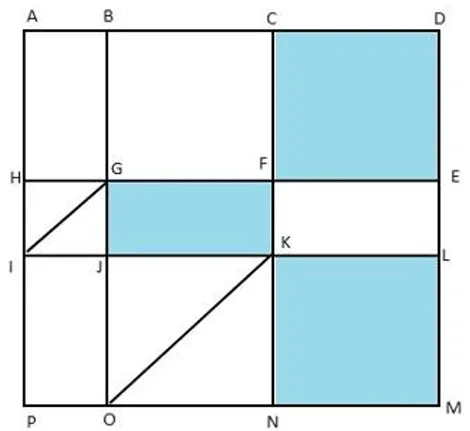
The above is a schematic diagram of walkways (indicated by all the straight-lines) and lakes (3 of them, each in the shape of rectangles– shaded in the diagram) of a gated area. Different points on the walkway are indicated by letters (A through P) with distances being OP = 150 m, ON = MN = 300 m, ML = 400 m, EL = 200 m, DE = 400 m. The following additional information about the facilities in the area is known. 1. The only entry/exit point is at C. 2. There are many residences within the gated area; all of them are located on the path AH and ML with four of them being at A, H, M, and L. 3. The post office is located at P and the bank is located at B.
Oneresident takes a walk within the gated area starting from A and returning to A without going through any point (other than A) more than once. What is the maximum distance (in m) she can walk in this way?
Solution :
The correct answer is 5100.
To find the maximum distance a resident can walk starting from point A and returning to A without visiting any other point more than once, we need to find a simple cycle (a closed loop) that starts and ends at A and visits the maximum possible number of points while maximizing the total walkway distance.
Based on the schematic diagram, we have 16 points labeled from A through P arranged in a grid-like network:
• Level 1 (Top horizontal line): A, B, C, D
• Level 2: H, G, F, E
• Level 3: I, J, K, L
• Level 4 (Bottom horizontal line): P, O, N, M
Using the dimensions provided in the prompt, we can determine the lengths of the walkways:
• Horizontal segments:
• Vertical segments:
To maximize the distance, we can visit all 16 vertices in a single loop. Let's trace a path that starts at A, visits every vertex exactly once, and returns to A:
1. Start at A, walk to B:
2. From B, walk down to G:
3. From G, walk right to F:
4. From F, walk up to C:
5. From C, walk right to D:
6. From D, walk down to E:
7. From E, walk down to L:
8. From L, walk down to M:
9. From M, walk left to N:
10. From N, walk up to K:
11. From K, walk left to J:
12. From J, walk down to O:
13. From O, walk left to P:
14. From P, walk up to I:
15. From I, walk up to H:
16. From H, walk up to A:
Summing these segment distances:
This path covers all vertices exactly once and gives the maximum walk distance of 5100 m.
Completely free for students. Educators & coaching institutes get 2 months free Pro trial to create tests.
Access unlimited practice questions, detailed step-by-step solutions, and exam study materials — completely free for students.
Create and conduct professional online assessments with AI question generation, tab proctoring, and comprehensive batch management.

Practice the complete CLAT 2015 UG Question Paper to improve your preparation for the Common Law Admission Test. This previous year paper covers the key sections of CLAT UG, including English, General Knowledge & Current Affairs, Elementary Mathematics, Legal Aptitude, and Logical Reasoning. Solve CLAT 2015 UG questions to understand the previous year exam pattern, practice important concepts, improve accuracy and speed, and prepare effectively for law entrance examinations.

Prepare for CLAT 2019 UG with the complete question paper and solutions. This paper covers all major sections of the Common Law Admission Test (CLAT) Undergraduate exam, including English Language, Current Affairs & General Knowledge, Legal Reasoning, Logical Reasoning, and Quantitative Techniques.Use the CLAT 2019 UG question paper to practice exam-level questions, understand the question pattern, improve time management, and strengthen your preparation for law entrance examinations.
Copyright © 2026 Combe Labs Private Limited. All Rights Reserved.


