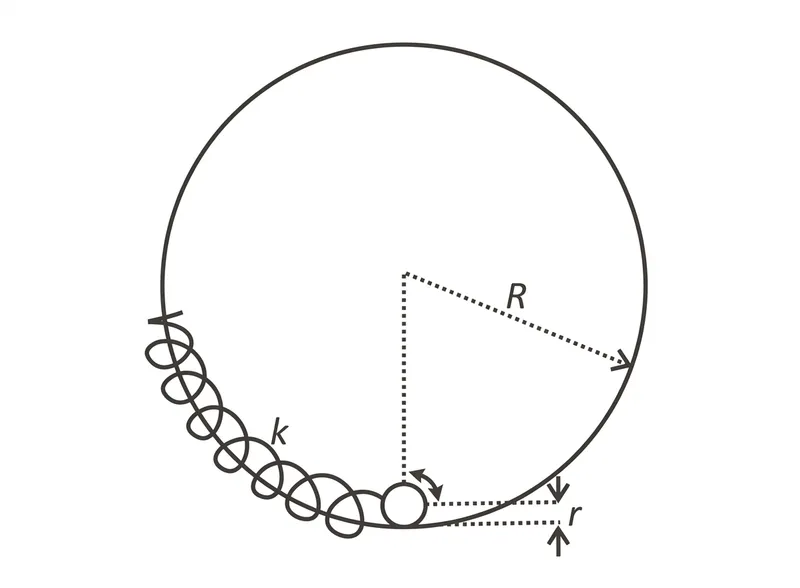
The center of a disk of radius 𝑟 and mass m is attached to a spring of spring constant k, inside a ring of radius R > r as shown in the figure. The other end of the spring is attached on the periphery of the ring. Both the ring and the disk are in the same vertical plane. The disk can only roll along the inside periphery of the ring, without slipping. The spring can only be stretched or compressed along the periphery of the ring, following the Hooke’s law. In equilibrium, the disk is at the bottom of the ring. Assuming small displacement of the disc, the time period of oscillation of center of mass of the disk is written as T=2π/ω. The correct expression for ω is (𝑔 is the acceleration due to gravity):
Correct Answer :
Solution :
The correct option is:
Step-by-step Derivation:
Let represent the angular displacement of the center of mass of the disk from its equilibrium position (the lowest point of the ring). The center of the disk moves along a circular path of radius centered at the center of the ring.
1. Kinetic Energy of the Disk
The disk undergoes both translational motion of its center of mass and rotational motion about its center of mass.
The velocity of the center of mass of the disk is given by:
Since the disk rolls without slipping on the inner surface of the ring, its angular velocity about its center of mass is related to the angular displacement by the rolling constraint:
Which gives:
The moment of inertia of the disk about its center of mass is:
The total kinetic energy is the sum of translational and rotational kinetic energies:
Substituting and :
2. Potential Energy of the System
The total potential energy of the system consists of gravitational potential energy and spring potential energy. Taking the lowest point (equilibrium) as the reference for gravitational potential energy:
For small angular displacements , we can use the approximation :
Since the spring is attached to the center of the disk and follows the periphery of the ring, the stretch in the spring when the center of mass moves by an angle is equal to the arc length:
The elastic potential energy stored in the spring is:
Thus, the total potential energy is:
3. Equation of Motion
The total mechanical energy is conserved:
Differentiating with respect to time ():
Dividing by :
This is the standard equation of simple harmonic motion, , where:
Access expert-curated educational resources and study materials—completely free.
Create, conduct, and manage professional online assessments with Mindyard. Perfect for teachers and institutes.
Copyright © 2026 Mindyard. All Rights Reserved.