The compound that will undergo SN1 reaction with the fastest rate is
Options
Correct Answer :
Solution :
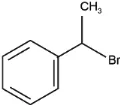
The correct compound is (1-bromoethyl)benzene (the structure shown in the fourth image, ).
Reasoning:
The rate of an SN1 reaction depends directly on the stability of the carbocation intermediate formed in the rate-determining step (loss of the leaving group, ). Let us analyze the carbocations formed by each of the given compounds:
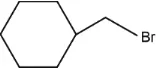
1. (Bromomethyl)cyclohexane (first image):
This is a primary alkyl halide. Upon loss of the bromide ion, it forms a primary carbocation:
Primary carbocations are highly unstable, resulting in an extremely slow rate of SN1 reaction.
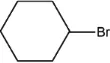
2. Bromocyclohexane (second image):
This is a secondary alkyl halide. Upon loss of the bromide ion, it forms a secondary cyclohexyl carbocation:
A secondary carbocation is moderately stable, but lacks resonance stabilization.
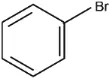
3. Bromobenzene (third image):
This is an aryl halide. The carbon-bromine bond has partial double-bond character due to resonance, making it very strong. Additionally, forming a phenyl carbocation is extremely unfavorable:
Therefore, aryl halides do not undergo SN1 reactions under normal conditions.
4. (1-Bromoethyl)benzene (fourth image):
This is a secondary benzylic halide. Upon loss of the bromide ion, it forms a secondary benzylic carbocation:
This carbocation is highly stabilized by resonance conjugation with the pi-electrons of the aromatic benzene ring, allowing the positive charge to be delocalized over multiple ring positions. As a result, this intermediate forms very rapidly, leading to the fastest SN1 reaction rate among the choices.
Access expert-curated educational resources and study materials—completely free.
Create, conduct, and manage professional online assessments with Mindyard. Perfect for teachers and institutes.
Copyright © 2026 Mindyard. All Rights Reserved.