The compound that will undergo SN1 reaction with the fastest rate is
Options
 .
.
 .
.
 .
.
 .
.
Correct Answer :
.
Solution :
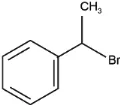
The correct answer is the fourth compound, (1-bromoethyl)benzene (shown in the fourth image).
Step-by-Step Explanation:
1. Understanding the SN1 Reaction Mechanism:
The SN1 (Substitution Nucleophilic Unimolecular) reaction proceeds via a two-step mechanism:
• Step 1 (Rate-determining step): The leaving group (bromide ion, Br-) departs, forming a carbocation intermediate.
• Step 2: The nucleophile attacks the carbocation intermediate to form the final product.
Since the first step is the rate-determining step, the rate of an SN1 reaction depends directly on the stability of the carbocation intermediate formed. A more stable carbocation leads to a lower activation energy for the first step, resulting in a faster reaction rate.
2. Analyzing the Carbocations Formed by Each Option:
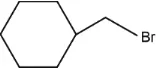
• First Compound (cyclohexylmethyl bromide):
This is a primary alkyl halide. Upon loss of the leaving group (Br-), it forms a primary carbocation (cyclohexylmethyl carbocation):
Primary carbocations are highly unstable due to the lack of sufficient inductive effect and hyperconjugation stabilization.
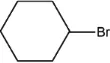
• Second Compound (bromocyclohexane):
This is a secondary alkyl halide. Upon loss of the leaving group, it forms a secondary carbocation (cyclohexyl carbocation):
Secondary carbocations are moderately stable due to hyperconjugation and inductive effects from the adjacent alkyl groups.
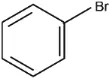
• Third Compound (bromobenzene):
This is an aryl halide. The carbon atom attached to the bromine is sp2 hybridized, and the lone pairs on the bromine atom undergo resonance with the aromatic ring, giving the C-Br bond partial double-bond character. Consequently, breaking this bond is extremely difficult. If it were to ionize, it would form a phenyl cation:
The phenyl cation is highly unstable because the positive charge is located in an sp2 orbital that cannot be stabilized by resonance with the aromatic system. Thus, bromobenzene does not undergo SN1 reactions under normal conditions.
• Fourth Compound ((1-bromoethyl)benzene):
This is a secondary benzylic halide. Upon ionization, it forms a secondary benzylic carbocation:
This carbocation is highly stable because the positive charge is adjacent to the benzene ring, allowing it to be delocalized into the aromatic pi system through resonance. This resonance stabilization is significantly greater than the stabilization provided by simple inductive effects or hyperconjugation.
3. Conclusion:
Comparing the stability of the resulting carbocations:
Secondary benzylic carbocation > Secondary carbocation > Primary carbocation > Phenyl cation
Because the carbocation formed from (1-bromoethyl)benzene is the most stable, it will undergo the SN1 reaction with the fastest rate.
Access expert-curated educational resources and study materials—completely free.
Create, conduct, and manage professional online assessments with Mindyard. Perfect for teachers and institutes.
Copyright © 2026 Mindyard. All Rights Reserved.