
The correct reaction/reaction sequence that would produce a dicarboxylic acid as the major product is
Options
Solution :
The correct option is C.
To determine which reaction sequence produces a dicarboxylic acid as the major product, we analyze the reaction steps for each option:
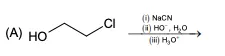
Option A:
The starting material is 3-chloropropan-1-ol:
1. Nucleophilic substitution with cyanide ion () from replaces the chloride leaving group, yielding a hydroxynitrile:
2. Hydrolysis of the nitrile group () under basic conditions () followed by acidic workup () converts the nitrile group to a carboxylic acid group ():
This product is 4-hydroxybutanoic acid, which contains only one carboxylic acid group (a monocarboxylic acid). Therefore, Option A is incorrect.
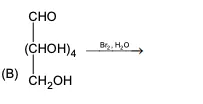
Option B:
The starting material is D-glucose:
When treated with bromine water (), which is a mild oxidizing agent, only the terminal aldehyde group () is oxidized to a carboxylic acid group (). The primary alcohol group () remains unaffected:
This reaction yields gluconic acid, which is a monocarboxylic acid. Therefore, Option B is incorrect.
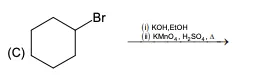
Option C:
The starting material is bromocyclohexane:
1. Treatment with potassium hydroxide in ethanol () under heating promotes a dehydrohalogenation (E2 elimination) reaction, eliminating to produce cyclohexene:
2. Treating cyclohexene with hot, acidic potassium permanganate () causes oxidative cleavage of the carbon-carbon double bond (). Both alkene carbons are oxidized to carboxylic acid groups:
This opens the ring and yields adipic acid (hexanedioic acid), which contains two carboxylic acid groups (a dicarboxylic acid). Therefore, Option C is correct.
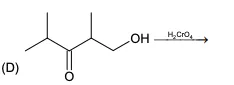
Option D:
The starting material represents a cyclic ketone. The reagents do not lead to the ring opening or oxidative functionalization required to generate a dicarboxylic acid as the major product. Therefore, Option D is incorrect.
Completely free for students. Educators & coaching institutes get 2 months free Pro trial to create tests.
Access unlimited practice questions, detailed step-by-step solutions, and exam study materials — completely free for students.
Create and conduct professional online assessments with AI question generation, tab proctoring, and comprehensive batch management.

A comprehensive JEE Advanced 2022 Paper 1 designed to help aspirants understand the examination pattern, difficulty level, and question trends of JEE Advanced. This paper covers important concepts from Physics, Chemistry, and Mathematics, featuring a balanced mix of conceptual, numerical, and advanced application-based questions. It helps students strengthen conceptual understanding, enhance analytical and problem-solving skills, and improve speed and accuracy. Ideal for practice, revision, self-assessment, previous year trend analysis, concept reinforcement, and time management, this paper is a valuable resource for effective JEE Advanced preparation.

A comprehensive JEE Advanced 2022 Paper 2 designed to help aspirants understand the examination pattern, difficulty level, and question trends of JEE Advanced. This paper covers important concepts from Physics, Chemistry, and Mathematics, featuring a balanced mix of conceptual, numerical, and advanced application-based questions. It helps students strengthen conceptual understanding, enhance analytical and problem-solving skills, and improve speed and accuracy. Ideal for practice, revision, self-assessment, previous year trend analysis, concept reinforcement, and time management, this paper is a valuable resource for effective JEE Advanced preparation.
Copyright © 2026 Combe Labs Private Limited. All Rights Reserved.


