The crank of a slider-crank mechanism rotates counter-clockwise (CCW) with a constant angular velocity w, as shown. Assume the length of the crank to be r.
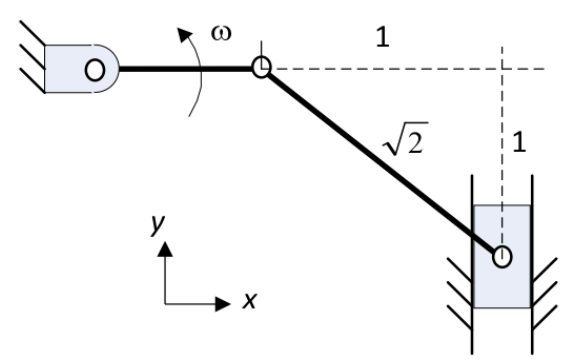
Using exact analysis, the acceleration of the slider in the y-direction, at the instant shown, where the crank is parallel to x-axis, is given by
Correct Answer :
ω²r
Solution :
To find the acceleration of the slider in the y-direction using exact analysis, we define the coordinate system with the origin at the crank pin pivot .
Let be the angle of the crank relative to the positive x-axis. The coordinates of the crank pin are given by:
The slider is constrained to move along the vertical direction. From the diagram, when the crank is horizontal (), the horizontal distance between and is . Therefore, the constant x-coordinate of the slider is:
The length of the connecting rod is given as . The distance formula between and gives:
Substituting , , , and into the equation:
Differentiating this equation with respect to time , keeping in mind that is constant:
Simplifying by dividing by 2:
At the instant shown in the diagram, the crank is parallel to the x-axis, meaning , , and . Also, the vertical position of the slider B is .
Substituting these values to find the slider velocity :
To find the acceleration, we differentiate the simplified first derivative equation with respect to time once more:
Using the product rule, the first term differentiates to:
At , this becomes:
The second term differentiates to:
At and substituting :
Combining the results of both differentiated parts:
Thus, the acceleration of the slider in the y-direction at this instant is .
Access expert-curated educational resources and study materials—completely free.
Create, conduct, and manage professional online assessments with Mindyard. Perfect for teachers and institutes.
Copyright © 2026 Mindyard. All Rights Reserved.