
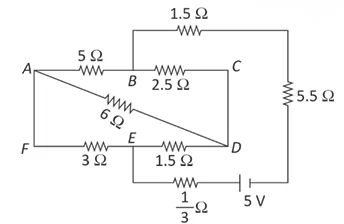
The current passing through the battery in the given circuit is:
Solution :
The correct answer is 0.5 A.
To find the current passing through the battery in the given circuit, we can analyze the resistor network step-by-step by identifying the nodes and simplifying the circuit connections.
Step 1: Identify the Nodes and Simplify the Circuit
By looking at the circuit diagram:
- The wire segment between points A and F has no components, which means node A and node F are at the same electrical potential (Node Node ).
- Similarly, the wire segment between points C and D has no components, meaning node C and node D are at the same electrical potential (Node Node ).
Now we can identify the resistors connected between the main nodes (A, B, D, and E):
- Between nodes A and B:
- Between nodes B and D (since C = D):
- Between nodes A and E (since F = A):
- Between nodes E and D:
- Between nodes A and D:
Step 2: Analyze the Balanced Wheatstone Bridge
The network formed by the nodes A, B, D, and E with terminals at B and E represents a Wheatstone bridge where:
- The ratio of the left arms is:
- The ratio of the right arms is:
Since the ratio of the arms is equal:
The Wheatstone bridge is balanced. Consequently, no current flows through the central diagonal resistor , and it can be removed from our calculations.
Step 3: Calculate the Equivalent Resistance of the Bridge Network ()
With the resistor removed, the circuit simplifies to two parallel branches connected between terminals B and E:
1. Upper path (B → A → E):
2. Lower path (B → D → E):
The equivalent resistance between nodes B and E is:
Step 4: Find the Total Equivalent Resistance of the Circuit
The bridge network () is connected in series with the rest of the loop containing:
- The resistor at the top
- The resistor on the right
- The resistor at the bottom
The total resistance is:
Step 5: Calculate the Total Current
Using Ohm's Law, the current passing through the battery is:
Completely free for students. Educators & coaching institutes get 2 months free Pro trial to create tests.
Access unlimited practice questions, detailed step-by-step solutions, and exam study materials — completely free for students.
Create and conduct professional online assessments with AI question generation, tab proctoring, and comprehensive batch management.

A comprehensive JEE Advanced 2022 Paper 1 designed to help aspirants understand the examination pattern, difficulty level, and question trends of JEE Advanced. This paper covers important concepts from Physics, Chemistry, and Mathematics, featuring a balanced mix of conceptual, numerical, and advanced application-based questions. It helps students strengthen conceptual understanding, enhance analytical and problem-solving skills, and improve speed and accuracy. Ideal for practice, revision, self-assessment, previous year trend analysis, concept reinforcement, and time management, this paper is a valuable resource for effective JEE Advanced preparation.

A comprehensive JEE Advanced 2022 Paper 2 designed to help aspirants understand the examination pattern, difficulty level, and question trends of JEE Advanced. This paper covers important concepts from Physics, Chemistry, and Mathematics, featuring a balanced mix of conceptual, numerical, and advanced application-based questions. It helps students strengthen conceptual understanding, enhance analytical and problem-solving skills, and improve speed and accuracy. Ideal for practice, revision, self-assessment, previous year trend analysis, concept reinforcement, and time management, this paper is a valuable resource for effective JEE Advanced preparation.
Copyright © 2026 Combe Labs Private Limited. All Rights Reserved.


