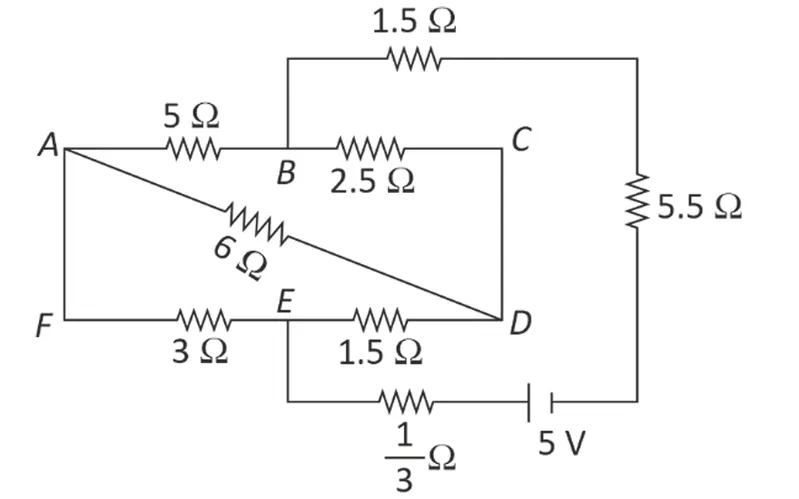
The current passing through the battery in the given circuit, is:
Correct Answer :
0.5 A
Solution :
To find the current passing through the battery, we can simplify the given circuit by analyzing the resistor network between nodes B and E.
Step 1: Simplify the connections in the circuit
By looking at the circuit diagram:
- Nodes A and F are connected directly by a zero-resistance wire, so they are at the same electrical potential ().
- Nodes C and D are also connected directly by a zero-resistance wire, so they are at the same electrical potential ().
Step 2: Identify the Wheatstone Bridge
Let us analyze the resistor network between the terminals B and E:
- Resistor between B and A:
- Resistor between B and D (via C):
- Resistor between A (via F) and E:
- Resistor between E and D:
- Diagonal resistor between A and D:
Let's check the ratio of the opposite arms of the bridge:
Since the ratio is equal:
This forms a balanced Wheatstone bridge. Consequently, the potential at node A is equal to the potential at node D (). No current flows through the diagonal resistor, and it can be removed from the calculation.
Step 3: Calculate the equivalent resistance of the bridge ()
With the resistor removed, the circuit consists of two parallel branches connected between B and E:
- Upper branch:
- Lower branch:
The equivalent resistance is:
Step 4: Calculate the total resistance of the circuit ()
The battery of is connected in series with the bridge network (), the upper external resistors, and the lower external resistor:
- Upper external resistance:
- Lower external resistance:
- Bridge equivalent resistance:
Thus, the total resistance is:
Step 5: Calculate the current passing through the battery ()
Using Ohm's law:
The correct answer is 0.5 A.
Access expert-curated educational resources and study materials—completely free.
Create, conduct, and manage professional online assessments with Mindyard. Perfect for teachers and institutes.
Copyright © 2026 Mindyard. All Rights Reserved.