The cytological observations made in a number of insects led to the development of the concept of genetic/chromosomal basis of sex-determination mechanism. Honey bee is an interesting example to study the mechanism of sex-determination. Study the schematic cross between the male and the female honey bees given below. Answer the questions that follow.
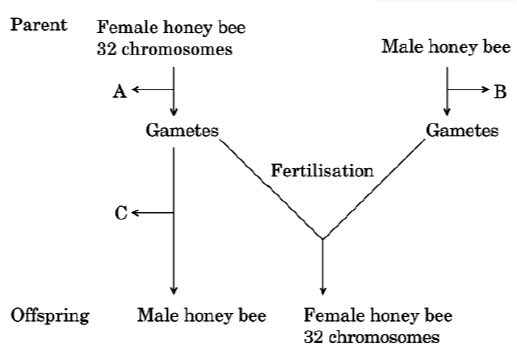
(a) Identify the cell divisions ‘A’ and ‘B’ that lead to gamete formation in female and male honey bees respectively.
(b) Name the process ‘C’ that leads to the development of male honey bee (drone).
Correct Answer :
(a)
‘A’ - meiosis
‘B’-Mitosis
(b) ‘C’-Parthenogenesis
Solution :
Correct Answer:
(a) ‘A’ - meiosis, ‘B’ - Mitosis
(b) ‘C’ - Parthenogenesis
Step-by-Step Explanation:
1. Understanding the Sex-Determination System in Honey Bees:
Honey bees exhibit a unique sex-determination mechanism known as the haplodiploid system. In this system, sex is determined by the number of chromosome sets an individual receives. Females (queens and workers) are diploid, meaning they develop from fertilized eggs, whereas males (drones) are haploid, meaning they develop from unfertilized eggs.
2. Identification of Cell Division ‘A’ (in Female Honey Bee):
As labeled in the schematic diagram, the parent "Female honey bee" contains "32 chromosomes", which represents the diploid chromosome count:
To produce haploid gametes (eggs containing chromosomes), the diploid female must undergo a reductional cell division. This reduction division is meiosis. Therefore, cell division ‘A’ is meiosis.
3. Identification of Cell Division ‘B’ (in Male Honey Bee):
The parent "Male honey bee" is haploid, carrying only 16 chromosomes:
Since a haploid organism cannot undergo reduction division, it must produce its haploid gametes (sperm containing chromosomes) through an equational cell division. This division is mitosis. Therefore, cell division ‘B’ is mitosis.
4. Identification of Process ‘C’ (Development of Male Offspring):
The schematic shows that a gamete (egg) from the female bee directly develops into a "Male honey bee" offspring under label ‘C’ without undergoing "Fertilisation". The biological process of development of an organism from an unfertilized egg is called parthenogenesis. Therefore, process ‘C’ is parthenogenesis.
Access expert-curated educational resources and study materials—completely free.
Create, conduct, and manage professional online assessments with Mindyard. Perfect for teachers and institutes.
Copyright © 2026 Mindyard. All Rights Reserved.
 Set - 3-1782888548748.webp)