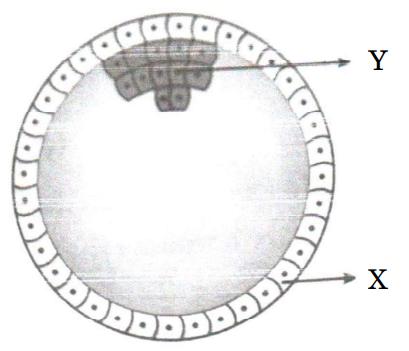
The diagram given below shows a developmental stage of human embryo. Answer the following questions with reference to it :
(a) Identify and name the human embryonic stage shown.
(b) Mention its exact location in the normal pregnancy of a woman.
(c) Write one function of each of the two parts labelled 'X' and 'Y'.
Correct Answer :
(a) Blastocyst
(b) Uterine wall/endometrium/innermost layer of uterine wall.
(c)
(Outer layer/trophoblast) ‘X’- helps in implantation in uterus/attachment to endometrium.
(Inner cell mass) ‘Y’- gets differentiated into embryo
Solution :
Correct Answer:
(a) Blastocyst
(b) Uterine wall/endometrium/innermost layer of uterine wall.
(c) (Outer layer/trophoblast) ‘X’ - helps in implantation in uterus/attachment to endometrium.
(Inner cell mass) ‘Y’ - gets differentiated into embryo.
Explanation:
(a) Identification of the Embryonic Stage:
The provided diagram depicts a characteristic developmental stage of a mammalian embryo consisting of a hollow sphere of cells. In the image, we can observe an outer ring of single-layered cells, a large central cavity (blastocoel), and a distinct cluster of cells localized at one pole. This structure is identified as the blastocyst, which forms approximately 5 to 6 days after fertilization in humans.
(b) Location in Normal Pregnancy:
During a normal pregnancy, the blastocyst reaches the uterine cavity where it undergoes implantation. The exact site of this process is the uterine wall, specifically the endometrium (the innermost lining of the uterus), where it embeds itself to establish nutritional and physical support from the mother.
(c) Functions of labelled parts 'X' and 'Y':
- Part 'X' (Outer layer / Trophoblast): In the diagram, the label 'X' points to the outer cell layer surrounding the blastocyst cavity. This layer is the trophoblast, and its primary function is to attach to the endometrium, thereby helping in the implantation of the embryo in the uterus.
- Part 'Y' (Inner cell mass / Embryoblast): The label 'Y' points to the internal cluster of cells attached to the inner side of the trophoblast. This is the inner cell mass, which eventually differentiates to form the embryo and all of its specialized body tissues.
Access expert-curated educational resources and study materials—completely free.
Create, conduct, and manage professional online assessments with Mindyard. Perfect for teachers and institutes.
Copyright © 2026 Mindyard. All Rights Reserved.
 Set - 3-1782888548748.webp)