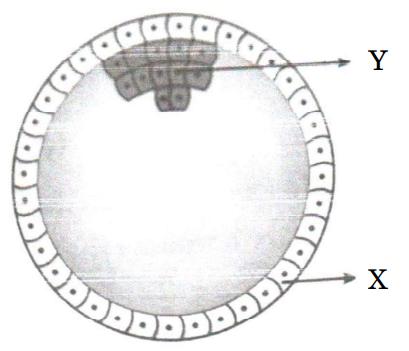
The diagram given below shows a developmental stage of human embryo. Answer the following questions with reference to it :
(a) Identify and name the human embryonic stage shown.
(b) Mention its exact location in the normal pregnancy of a woman.
(c) Write one function of each of the two parts labelled 'X' and 'Y' .
Correct Answer :
(a) Blastocyst
(b) Uterine wall/endometrium/innermost layer of uterine wall.
(c) (Outer layer/trophoblast) ‘X’- helps in implantation in uterus/attachment to
endometrium.
(Inner cell mass) ‘Y’- gets differentiated into embryo.
Solution :
Correct Answer:
(a) Blastocyst
(b) Uterine wall/endometrium/innermost layer of uterine wall.
(c) (Outer layer/trophoblast) ‘X’ - helps in implantation in uterus/attachment to endometrium.
(Inner cell mass) ‘Y’ - gets differentiated into embryo.
Step-by-Step Explanation:
(a) Identification of the Embryonic Stage:
The diagram shows a circular, fluid-filled embryonic structure consisting of an outer cellular ring and an inner cluster of cells clustered at one pole. This specific developmental stage of the human embryo is called the blastocyst. It develops from the morula (a solid ball of cells) about 5–6 days after fertilization.
(b) Location during Normal Pregnancy:
During a normal, healthy pregnancy, the blastocyst reaches the uterine cavity after traveling through the fallopian tube. It implants itself by embedding into the uterine wall, specifically the endometrium, which is the highly vascularized, innermost lining of the uterus.
(c) Analysis and Functions of the Labelled Parts:
By analyzing the provided image, we can identify the two main components of the blastocyst:
• Label 'X' (Trophoblast): This points to the single outer layer of cells surrounding the blastocyst cavity. Its primary function is to facilitate implantation by attaching to the endometrium of the uterus. It also plays a key role in forming the fetal portion of the placenta.
• Label 'Y' (Inner Cell Mass / Embryoblast): This points to the inner group of cells clustered at one end of the cavity. Its main function is to differentiate into the actual embryo, eventually forming all the tissues and organs of the developing fetus.
Access expert-curated educational resources and study materials—completely free.
Create, conduct, and manage professional online assessments with Mindyard. Perfect for teachers and institutes.
Copyright © 2026 Mindyard. All Rights Reserved.
 Set - 3-1782888548748.webp)