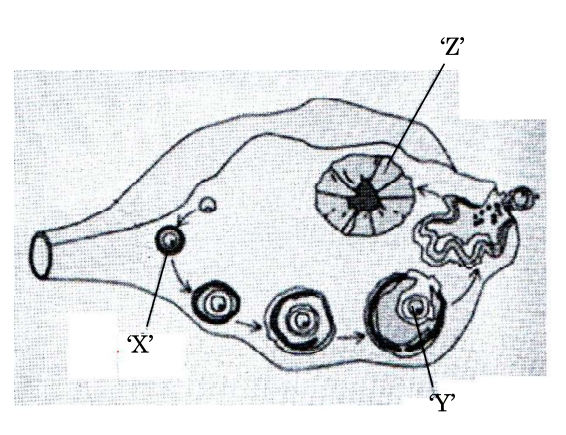
The diagram given below shows the events occurring in an ovary during in a human female. (a) Identify 'X'. Mention the time when the process occurs in a human female. (b) Identify 'Y'. When and how is it formed ? (c) Name the hormone produced by 'Z'.
Correct Answer :
(a)
• Primary follicle
• During fetal stage
(b)
• Secondary Oocyte
• At follicular phase/ between 6-13 day of menstrual cycle
• Tertiary follicle grows in size and completes its first meiotic division and this unequal division results in a large haploid secondary Oocyte and a tiny first polar body.
(c) Progesterone
Solution :
Correct Answer:
(a) 'X' is the Primary follicle, which is formed during the fetal stage.
(b) 'Y' is the Secondary Oocyte. It is formed during the follicular phase (between the 6th to 13th day of the menstrual cycle) when the tertiary follicle grows in size and completes its first meiotic division, resulting in a large haploid secondary oocyte and a tiny first polar body.
(c) The hormone produced by 'Z' (corpus luteum) is progesterone.
Step-by-step Explanation:
(a) Identification and Timeline of 'X':
In the provided cross-sectional diagram of a human ovary, the label 'X' points to an early-stage developing follicle. This is the primary follicle, which consists of a primary oocyte surrounded by a single layer of cuboidal granulosa cells.
These follicles are formed early in life during the fetal development stage of a female fetus. At birth, a female's ovaries already contain all the primary follicles she will ever have, and no more are formed after birth.
(b) Identification, Timeline, and Formation of 'Y':
The label 'Y' points to the cell housed within the large, fluid-filled cavity of the mature follicle prior to ovulation. This cell is the secondary oocyte.
• When is it formed? It is formed during the follicular phase of the menstrual cycle, specifically between days 6 and 13 of a standard 28-day cycle.
• How is it formed? During the maturation process, the primary follicle grows into a secondary and then a tertiary follicle. The primary oocyte within the tertiary follicle resumes and completes its first meiotic division. This division is highly unequal, dividing the nuclear material equally but the cytoplasm unequally, resulting in a large haploid secondary oocyte (which retains almost all the nutrient-rich cytoplasm) and a small, non-functional first polar body.
(c) Identification and Hormone Secretion of 'Z':
The label 'Z' points to the glandular, yellow body that remains in the ovary after ovulation (the release of the secondary oocyte). This structure is known as the corpus luteum.
The corpus luteum acts as a temporary endocrine gland and primarily secretes the hormone progesterone. Progesterone plays a vital role in thickening and maintaining the endometrial lining of the uterus to prepare it for pregnancy if fertilization occurs.
Access expert-curated educational resources and study materials—completely free.
Create, conduct, and manage professional online assessments with Mindyard. Perfect for teachers and institutes.
Copyright © 2026 Mindyard. All Rights Reserved.
 Set - 3-1782888548748.webp)