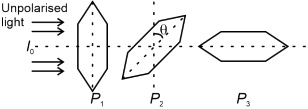
The diagram shows combination of polaroids.Unpolarised light of intensity I0 incident perpendicular to the axis of polaroid P1, then angle θ for which maximum intensity passes through polaroid P3
Correct Answer :
Solution :
Correct Answer: 45°
Step-by-Step Explanation:
1. Understanding the Setup from the Diagram:
Let us analyze the alignment of the transmission axes of the three polaroids shown in the image:
- The first polaroid, P1, has its transmission axis oriented vertically.
- The second polaroid, P2, has its transmission axis oriented at an angle θ with respect to the vertical axis of P1.
- The third polaroid, P3, has its transmission axis oriented horizontally, which is perpendicular to the vertical axis of P1.
2. Applying Malus's Law at each Polarisation stage:
Step 1: Transmission through P1
Initially, unpolarised light of intensity I0 is incident on the first polaroid P1. When unpolarised light passes through a polaroid, its intensity is reduced to exactly half, and it becomes linearly polarised along the transmission axis of the polaroid. Therefore, the intensity I1 after passing through P1 is:
Step 2: Transmission through P2
The light incident on P2 is now polarised vertically. Since the axis of P2 is at an angle θ to the vertical axis of P1, we use Malus's Law to calculate the transmitted intensity I2:
Step 3: Transmission through P3
The light passing out of P2 is polarised along the transmission axis of P2. This light is then incident on the third polaroid P3. Since the axis of P1 is vertical and the axis of P3 is horizontal, the angle between the vertical and the axis of P3 is 90°. The axis of P2 is inclined at an angle θ to the vertical, so the angle between the transmission axes of P2 and P3 is (90° - θ).
Applying Malus's Law once more, the final transmitted intensity I3 is:
Substituting the expression for I2 into the equation above:
Using the trigonometric double-angle identity, we can simplify this expression:
Squaring both sides gives:
Now, substitute this back into the formula for I3:
3. Finding the condition for Maximum Intensity:
The intensity of the light emerging from P3 is maximum when the value of the sine term is at its maximum value:
Taking the positive square root for acute angles:
Thus, the angle θ for which the maximum intensity of light passes through polaroid P3 is 45°.
Access expert-curated educational resources and study materials—completely free.
Create, conduct, and manage professional online assessments with Mindyard. Perfect for teachers and institutes.
Copyright © 2026 Mindyard. All Rights Reserved.