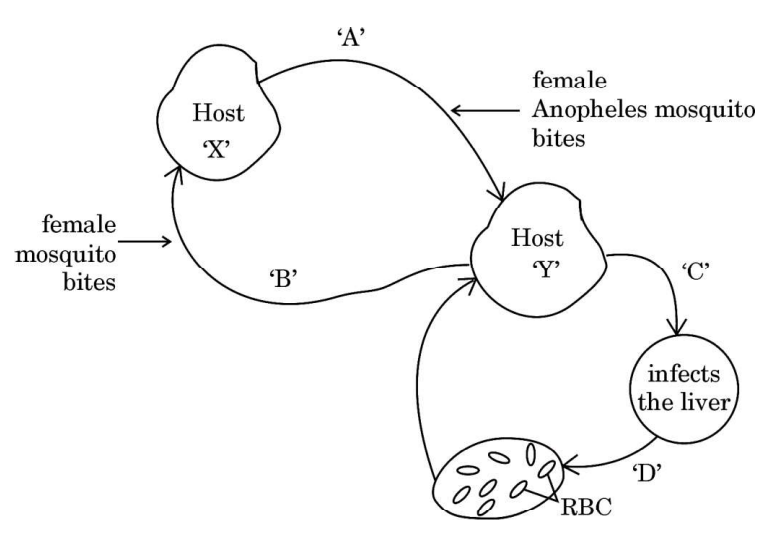
The diagram shows the life cycle of a pathogenic protozoan.
(i) Name the parasitic stage that is being transferred from host 'X' to host 'Y'.
(ii) Write the changes the parasite undergoes in the liver.
(iii) Write the changes the parasite undergoes when it enters the RBC.
(iv) a) Trace the changes the parasite undergoes when the host 'X' takes its blood meal from infected host 'Y'.
or
b) At which stage during the life cycle of the pathogen does the host 'Y' experience the symptoms of the disease? Name the disease and the toxic substance responsible for these symptoms.
Correct Answer :
(i) Sporozoites
(ii) Undergoes Asexual reproduction
(iii) The number increase asexually, parasites ultimately change into gametocytes/ undergoes gametogenesis
(iv)
a) Fertilization and development takes place in host ‘X’, ultimately forming the infective stage sporozoites.
or
b)
• Bursting of RBCs
• Malaria
• Haemozoin
Solution :
Correct Answer:
(i) Sporozoites
(ii) Undergoes asexual reproduction
(iii) The number increases asexually; parasites ultimately change into gametocytes / undergo gametogenesis
(iv) a) Fertilization and development take place in host 'X', ultimately forming the infective stage sporozoites.
or
(iv) b)
• Bursting of RBCs
• Malaria
• Haemozoin
Detailed Step-by-Step Explanation:
Analysis of the Diagram:
By analyzing the provided life cycle diagram, we can identify the following components and labels:
• Host 'X': The vector host, labeled with an arrow indicating a "female Anopheles mosquito bites" which transmits the parasite to Host 'Y'. Thus, Host 'X' is the female Anopheles mosquito.
• Host 'Y': The human host, which receives the parasite during the mosquito bite.
• Arrow 'A': Represents the transmission of the infective stage of the parasite from the mosquito (Host 'X') to the human (Host 'Y') during a bite.
• Arrow 'B': Represents the mosquito taking a blood meal from the infected human, taking up the parasite's sexual stages.
• Arrow 'C' and "infects the liver": Represents the initial phase of infection in the human host where the parasite migrates to and infects the liver cells.
• Arrow 'D' and "RBC": Represents the stage where parasites released from the liver enter the Red Blood Cells (RBCs) to continue their cycle.
Step-by-step Solution to each part:
(i) Identifying the parasite stage transferred from Host 'X' to Host 'Y':
When an infected female Anopheles mosquito (Host 'X') bites a human (Host 'Y'), it injects the infectious stage of the protozoan parasite Plasmodium into the human bloodstream along with its saliva. This infective stage is called a sporozoite (represented by 'A' in the diagram).
(ii) Changes the parasite undergoes in the liver:
Once sporozoites enter the human body, they reach the liver through the blood (indicated by arrow 'C'). In the hepatocytes (liver cells), the parasite undergoes asexual reproduction (multiple fission or schizogony). This increases their numbers drastically before they burst the liver cells and enter the bloodstream to target red blood cells.
(iii) Changes the parasite undergoes when it enters the RBC:
Upon entering the red blood cells (indicated by arrow 'D'), the parasites reproduce asexually to multiply in number. Eventually, some of these erythrocytic parasites differentiate into sexual stages called gametocytes (male and female gametocytes), preparing them for uptake by another mosquito. This transition process is known as gametogenesis.
(iv) Answer Option (a) OR (b):
Option a) Tracing changes when Host 'X' takes a blood meal from infected Host 'Y':
When a female Anopheles mosquito (Host 'X') bites an infected human (Host 'Y'), it ingests gametocytes during its blood meal (represented by arrow 'B'). These gametocytes reach the mosquito's gut where fertilization and further development take place. The fertilized zygote undergoes development, eventually migrating to the mosquito's salivary glands as infective sporozoites, ready to infect another human.
Option b) Symptoms, Disease Name, and Toxic Substance:
• Stage of Symptoms: The host experiences clinical symptoms (like recurring high fever and chills) when the infected red blood cells (RBCs) burst to release a new generation of parasites.
• Disease Name: The disease caused by this pathogenic protozoan is Malaria.
• Toxic Substance: The rupture of RBCs releases a toxic crystalline substance called haemozoin (derived from the digested hemoglobin of the host cell), which is directly responsible for triggering the characteristic chills and high fever.
Access expert-curated educational resources and study materials—completely free.
Create, conduct, and manage professional online assessments with Mindyard. Perfect for teachers and institutes.
Copyright © 2026 Mindyard. All Rights Reserved.
 Set - 3-1782888548748.webp)