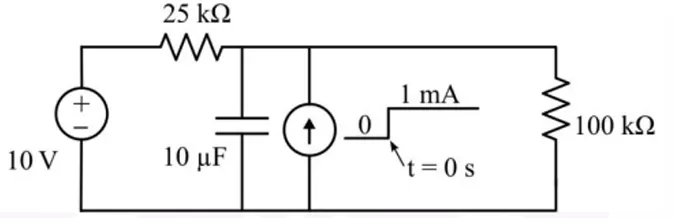
The electrical network shown has an independent voltage source (10 V) and a current source (1 u(t) mA). The voltage across the capacitor at time instants (in seconds) t = 0+, t = 0.50, and t = ∞, respectively, is:
Solution :
The correct option is 8.00 V, 26.36 V, 28.00 V.
Analysis of the Circuit Diagram:
Based on the provided circuit diagram:
Step 1: Finding the initial capacitor voltage at
For , the current source is inactive (, acting as an open circuit). Assuming the circuit has reached steady state, the capacitor acts as an open circuit.
The voltage across the capacitor is determined using the voltage divider formula between the source, the resistor, and the resistor:
Since the voltage across a capacitor cannot change instantaneously:
Step 2: Finding the steady-state voltage at
As , the capacitor once again acts as an open circuit in DC steady state, while the current source supplies a constant .
Applying Kirchhoff's Current Law (KCL) at the node above the capacitor:
Multiply the entire equation by to eliminate the denominators:
Step 3: Finding the time constant ()
The equivalent resistance connected across the capacitor is found by deactivating the independent sources (short-circuiting the source and open-circuiting the current source):
The time constant of the RC network is:
Step 4: Finding the voltage at
The transient response of the capacitor voltage for is given by:
Substituting the derived values:
Substitute :
Using the approximation :
Thus, the values of the capacitor voltage at , , and are , , and , respectively.
Completely free for students. Educators & coaching institutes get 2 months free Pro trial to create tests.
Access unlimited practice questions, detailed step-by-step solutions, and exam study materials — completely free for students.
Create and conduct professional online assessments with AI question generation, tab proctoring, and comprehensive batch management.

Prepare for success in the GATE Electrical Engineering exam with our comprehensive Ultimate Revision Test. Designed for aspirants aiming for top scores, this test covers all key topics in the GATE EE syllabus, including Circuit Theory, Electromagnetic Fields, Power Systems, Electrical Machines, Control Systems, and Analog & Digital Electronics. Our revision test offers a balanced mix of theory-based and application-based questions that will help you assess your understanding and boost your problem-solving skills. With carefully selected questions that mirror the difficulty level of the actual GATE exam, this test will help you identify areas for improvement and fine-tune your exam strategy.

Prepare for GATE 2026 Civil Engineering with the latest question papers, previous year papers, detailed solutions, syllabus, exam pattern, preparation tips, mock tests, and subject-wise study material. Download GATE 2026 CE question papers with solutions in PDF format and boost your preparation for top engineering institutes and PSU recruitment.
Copyright © 2026 Combe Labs Private Limited. All Rights Reserved.