
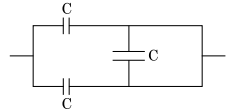
The equivalent capacitance of the combination shown in the figure is :
Solution :
The correct answer is 2C.
To find the equivalent capacitance of the given combination, let us label the key terminals and nodes in the circuit diagram:
1. Let the terminal on the far left be A.
2. Let the terminal on the far right be B.
3. The wire from terminal A splits into two branches, connecting directly to the left plate of the top capacitor (capacitance ) and the left plate of the bottom capacitor (capacitance ). Therefore, both of these plates are at the potential of terminal A.
4. Now, looking at the right side of the circuit, the right plates of the top and bottom capacitors are connected to each other by a wire that also connects directly to terminal B. This means the right plate of both the top and bottom capacitors are at the potential of terminal B.
5. The third capacitor (capacitance ) is connected vertically between these two wires. Since both wires are connected together to terminal B, both terminals of this vertical capacitor are at the same potential (potential of B). Thus, the potential difference across the vertical capacitor is zero, which means it is short-circuited and carries no charge. We can remove it from our calculations.
Consequently, the remaining circuit consists of only the top and bottom capacitors connected in parallel between terminal A and terminal B.
The equivalent capacitance () of two capacitors connected in parallel is the sum of their individual capacitances:
Thus, the equivalent capacitance of the combination is 2C.
Completely free for students. Educators & coaching institutes get 2 months free Pro trial to create tests.
Access unlimited practice questions, detailed step-by-step solutions, and exam study materials — completely free for students.
Create and conduct professional online assessments with AI question generation, tab proctoring, and comprehensive batch management.

A comprehensive JEE Advanced 2022 Paper 1 designed to help aspirants understand the examination pattern, difficulty level, and question trends of JEE Advanced. This paper covers important concepts from Physics, Chemistry, and Mathematics, featuring a balanced mix of conceptual, numerical, and advanced application-based questions. It helps students strengthen conceptual understanding, enhance analytical and problem-solving skills, and improve speed and accuracy. Ideal for practice, revision, self-assessment, previous year trend analysis, concept reinforcement, and time management, this paper is a valuable resource for effective JEE Advanced preparation.

A comprehensive JEE Advanced 2022 Paper 2 designed to help aspirants understand the examination pattern, difficulty level, and question trends of JEE Advanced. This paper covers important concepts from Physics, Chemistry, and Mathematics, featuring a balanced mix of conceptual, numerical, and advanced application-based questions. It helps students strengthen conceptual understanding, enhance analytical and problem-solving skills, and improve speed and accuracy. Ideal for practice, revision, self-assessment, previous year trend analysis, concept reinforcement, and time management, this paper is a valuable resource for effective JEE Advanced preparation.
Copyright © 2026 Combe Labs Private Limited. All Rights Reserved.


