
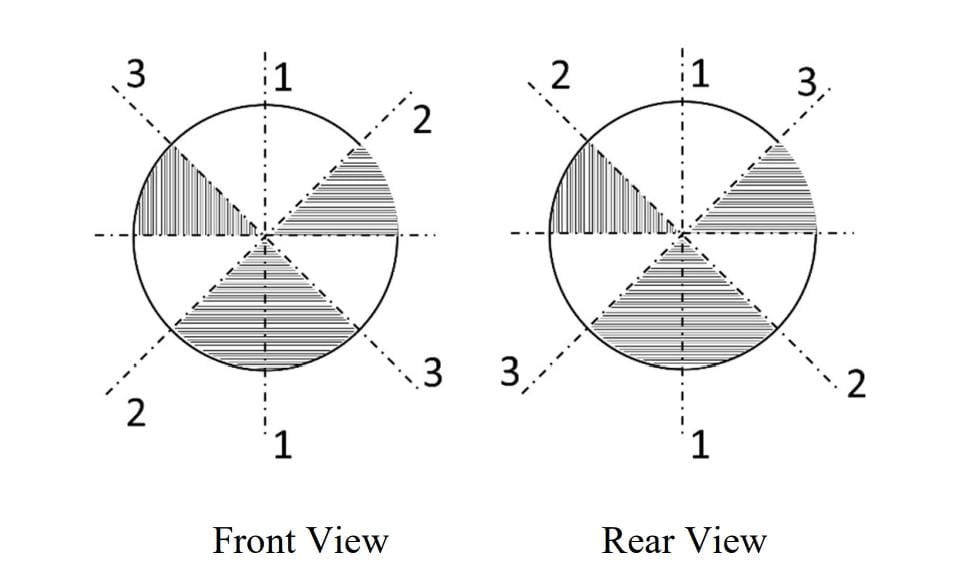
The figure below shows the front and rear view of a disc, which is shaded with identical patterns. The disc is flipped once with respect to any one of the fixed axes 1-1, 2-2 or 3-3 chosen uniformly at random. What is the probability that the disc DOES NOT retain the same front and rear views after the flipping operation?
Correct Answer :
2/3
Solution :
The correct option is 2/3.
1. Understanding the Initial Configuration:
Let us analyze the front and rear views of the disc shown in the image:
• The disc is divided into sectors by three axes (1-1, 2-2, and 3-3) and a horizontal reference axis.
• In the Front View, we observe:
- Axis 1-1 is vertical (at 90°).
- Axis 2-2 is diagonal, going from bottom-left to top-right (at 45°/225°).
- Axis 3-3 is diagonal, going from top-left to bottom-right (at 135°/315°).
- The sector in the top-left quadrant (between axis 3-3 and the horizontal axis, i.e., from 135° to 180°) is shaded with vertical lines.
- The sector in the top-right quadrant (between the horizontal axis and axis 2-2, i.e., from 0° to 45°) is shaded with horizontal lines.
- The bottom sector (between axis 2-2 and axis 3-3, i.e., from 225° to 315°) is shaded with horizontal lines.
• In the Rear View, the labels of the diagonal axes are reversed because of the perspective of looking from the back:
- Axis 2-2 now goes from top-left to bottom-right (at 135°/315°).
- Axis 3-3 now goes from bottom-left to top-right (at 45°/225°).
- The sector shading positions relative to the page remain identical (top-left is vertically shaded, top-right is horizontally shaded, and the bottom is horizontally shaded).
2. Analyzing the Flipping Operations:
A 3D flip of the disc by 180° about any axis swaps the front and rear faces. For the views to remain identical:
• The new front view (obtained by flipping the rear face to the front) must match the original front view.
• The new rear view (obtained by flipping the front face to the rear) must match the original rear view.
Case 1: Flipping about Axis 1-1 (vertical axis)
Flipping about the vertical axis 1-1 reflects the disc horizontally.
• For the Rear View, reflecting horizontally swaps the left and right sides:
- The top-left sector (vertically shaded) goes to the top-right.
- The top-right sector (horizontally shaded) goes to the top-left.
- The bottom sector (horizontally shaded and symmetric about the vertical axis 1-1) remains at the bottom.
• The axis labels also swap: Axis 2-2 (at 135° on the rear) goes to 45° (which is the position of Axis 2-2 on the front). Axis 3-3 (at 45° on the rear) goes to 135° (which is the position of Axis 3-3 on the front).
• Therefore, the resulting front view is identical to the original front view.
Thus, flipping about Axis 1-1 retains the same views.
Case 2: Flipping about Axis 2-2
Flipping about the diagonal axis 2-2 reflects the sectors across the 45° diagonal line.
• This reflection shifts the shaded sectors to new angular positions (for instance, the top-right sector shifts to the vertical top region between 45° and 90°), which are unshaded in the original views.
Thus, flipping about Axis 2-2 does NOT retain the same views.
Case 3: Flipping about Axis 3-3
Similarly, flipping about Axis 3-3 reflects the sectors across the 135° diagonal line, shifting the shaded patterns to different positions.
Thus, flipping about Axis 3-3 does NOT retain the same views.
3. Probability Calculation:
Out of the 3 equally likely axes:
• Number of axes that retain the views = 1 (Axis 1-1)
• Number of axes that DO NOT retain the views = 2 (Axis 2-2 and Axis 3-3)
Hence, the probability that the disc does not retain the same front and rear views after the flipping operation is:
Access expert-curated educational resources and study materials—completely free.
Create, conduct, and manage professional online assessments with Mindyard. Perfect for teachers and institutes.
Copyright © 2026 Mindyard. All Rights Reserved.