Question Details

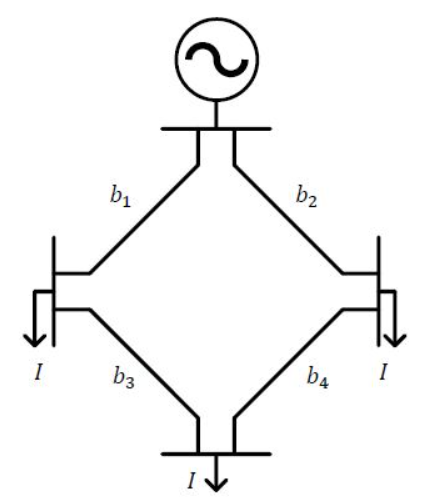
The figure show the single line diagram of a 4 - bus power network. Branches  b 2 , b 3 and  b 4 have impedance  4 z , z , 2 z and  4 z per - unit (pu), respectively, where  z = r + j x , with r > 0 and  x > 0. The current drawn from each load bus (marked as arrows) is equal to Ipu, where  I 0 . If the network to operate with minimum loss, the branch that should be opened is

Options

A

b1

B

b2

C

b3

D

b4

Show Answer

Correct Answer :

Option C

b3

Solution :

The correct option is b3.

Step-by-Step Analysis:

1. Network Parameters and Notation
Let us label the buses in the diagram as follows:

  • Bus 1: The source bus at the top, connected to the generator.
  • Bus 2: The load bus on the left, drawing a load current of I.
  • Bus 3: The load bus on the right, drawing a load current of I.
  • Bus 4: The load bus at the bottom, drawing a load current of I.

The branch impedances are given as:
zb1 = 4 z
zb2 = z
zb3 = 2 z
zb4 = 4 z
where z=r+jx. The resistance of each branch is directly proportional to the real part of its impedance:
Rb1 = 4 r
Rb2 = r
Rb3 = 2 r
Rb4 = 4 r

The total power loss in the network is given by:
Ploss = Ib12 Rb1 + Ib22 Rb2 + Ib32 Rb3 + Ib42 Rb4

2. Calculating Losses when Different Branches are Opened

Case 1: Branch b1 is opened (Ib1=0)
All power to the load buses must flow through branch b2.

  • Current in branch b3: carries the load of Bus 2 ⇒ Ib3=I
  • Current in branch b4: carries the loads of Bus 4 and Bus 2 ⇒ Ib4=2I
  • Current in branch b2: carries the loads of Bus 3, Bus 4, and Bus 2 ⇒ Ib2=3I
Total loss:
Ploss = (0)2 (4r) + (3I)2 (r) + (I)2 (2r) + (2I)2 (4r) = I2 r [ 0 + 9 + 2 + 16 ] = 27 I2 r

Case 2: Branch b2 is opened (Ib2=0)
All power to the load buses must flow through branch b1.

  • Current in branch b4: carries the load of Bus 3 ⇒ Ib4=I
  • Current in branch b3: carries the loads of Bus 4 and Bus 3 ⇒ Ib3=2I
  • Current in branch b1: carries the loads of Bus 2, Bus 4, and Bus 3 ⇒ Ib1=3I
Total loss:
Ploss = (3I)2 (4r) + (0)2 (r) + (2I)2 (2r) + (I)2 (4r) = I2 r [ 36 + 0 + 8 + 4 ] = 48 I2 r

Case 3: Branch b3 is opened (Ib3=0)
The network splits into two independent radial paths:

  • Path 1: Bus 1 → b1 → Bus 2. Current in branch b1 carries the load of Bus 2 ⇒ Ib1=I.
  • Path 2: Bus 1 → b2 → Bus 3 → b4 → Bus 4.
    • Current in branch b4 carries the load of Bus 4 ⇒ Ib4=I.
    • Current in branch b2 carries the loads of Bus 3 and Bus 4 ⇒ Ib2=2I.
Total loss:
Ploss = (I)2 (4r) + (2I)2 (r) + (0)2 (2r) + (I)2 (4r) = I2 r [ 4 + 4 + 0 + 4 ] = 12 I2 r

Case 4: Branch b4 is opened (Ib4=0)
The network splits into two independent radial paths:

  • Path 1: Bus 1 → b2 → Bus 3. Current in branch b2 carries the load of Bus 3 ⇒ Ib2=I.
  • Path 2: Bus 1 → b1 → Bus 2 → b3 → Bus 4.
    • Current in branch b3 carries the load of Bus 4 ⇒ Ib3=I.
    • Current in branch b1 carries the loads of Bus 2 and Bus 4 ⇒ Ib1=2I.
Total loss:
Ploss = (2I)2 (4r) + (I)2 (r) + (I)2 (2r) + (0)2 (4r) = I2r [ 16 + 1 + 2 + 0 ] = 19 I2r

Conclusion:
Comparing the four scenarios, the minimum power loss is 12I2r, which occurs when branch b3 is opened.

Unlock Our Free Library

Access expert-curated educational resources and study materials—completely free.

Discover more resources

You may also like

Ask AI Tutor
5 left
Q1 View Question & Options
AI Tutor is solving this question...
Reading question context & options...