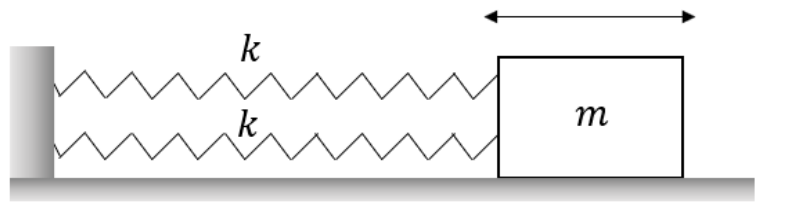
The figure shows a block of mass m = 20 kg attached to a pair of identical linear springs, each having a spring constant k = 1000 N/m. The block oscillates on a frictionless horizontal surface. Assuming free vibrations, the time taken by the block to complete ten oscillations is _________ seconds. (Rounded off to two decimal places)
Take π=3.14
Correct Answer :
6.28
-1716315746148.png)
Solution :
The correct answer is 6.28.
Step-by-Step Explanation:
1. Analysis of the Spring-Mass Configuration:
By analyzing the provided image, we observe a block of mass m attached to two identical linear springs, each labeled with a spring constant k. The two springs are arranged side-by-side (connected in parallel) between a vertical wall on the left and the block on the right. A double-headed horizontal arrow above the block indicates that it oscillates horizontally on a frictionless surface.
For two springs with spring constants k connected in parallel, the equivalent spring constant () is the sum of their individual spring constants:
Given parameters from the problem:
Mass of the block, m = 20 kg
Spring constant of each spring, k = 1000 N/m
Substituting the value of k, we calculate the equivalent spring stiffness:
2. Finding the Time Period of One Oscillation:
The time period (T) for one complete oscillation of a spring-mass system undergoing free vibration is given by:
Using the value of π = 3.14, we substitute the mass and equivalent spring constant:
First, simplify the division under the radical:
Now, compute the square root:
Calculate the single oscillation period (T):
3. Calculating the Time for Ten Oscillations:
The total time (t) required to complete ten complete oscillations is:
Substitute the value of T:
Thus, the time taken by the block to complete ten oscillations is 6.28 seconds.
Access expert-curated educational resources and study materials—completely free.
Create, conduct, and manage professional online assessments with Mindyard. Perfect for teachers and institutes.
Copyright © 2026 Mindyard. All Rights Reserved.