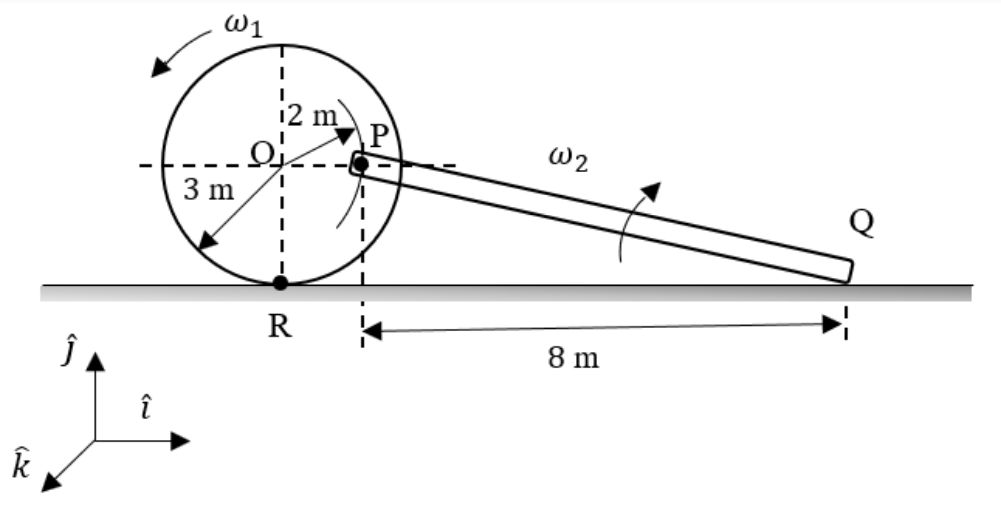
The figure shows a wheel rolling without slipping on a horizontal plane with angular velocity 𝜔1. A rigid bar PQ is pinned to the wheel at P while the end Q slides on the floor. What is the angular velocity 𝜔2of the bar PQ?
Correct Answer :
𝜔2 = 0.25𝜔1
Solution :
The correct answer is 𝜔2 = 0.25𝜔1.
Step-by-Step Analysis using the Instantaneous Center (I-Center) Method:
To find the relationship between the angular velocity of the wheel (𝜔1) and the angular velocity of the rigid bar PQ (𝜔2), we can define a coordinate system and locate the instantaneous centers of rotation of the components (links).
Let us label the bodies as follows:
- Link 1: The fixed horizontal floor.
- Link 2: The rolling wheel of radius 3 m.
- Link 3: The rigid bar PQ.
1. Locate the Instantaneous Centers of Rotation:
- I-Center I12: Since the wheel (Link 2) rolls without slipping on the flat floor (Link 1), the point of contact on the floor is its instantaneous center of rotation. Let us define this contact point as the origin:
- I-Center I23: This is the pin joint P connecting the wheel (Link 2) and the bar (Link 3). As shown in the diagram, the center of the wheel O is at a height of 3 m above the ground, meaning O is at (0, 3). The pin P is on the horizontal centerline of the wheel at a distance of 2 m to the right of O. Thus, the coordinates of P (I23) are:
- I-Center I13: This is the instantaneous center of rotation of the bar PQ (Link 3) relative to the floor (Link 1). Since the end Q of the bar slides horizontally along the floor, its velocity vector is horizontal. The line perpendicular to Q's velocity is a vertical line passing through Q.
The horizontal distance between the vertical projection of P and the end Q is given as 8 m. Therefore, the x-coordinate of Q is:
Thus, I13 must lie on the vertical line x = 10.
2. Apply Kennedy's Theorem of Three Centers:
According to Kennedy's Theorem, if three bodies have relative planar motion, their three relative instantaneous centers must lie on a straight line. Therefore, I12, I23, and I13 must be collinear.
We can find the equation of the line passing through I12 (0, 0) and I23 (2, 3):
Since I13 lies on the vertical line x = 10 and must also lie on the line of collinearity, we substitute x = 10 into the line equation to find its y-coordinate:
Thus, the coordinates of the instantaneous center of the bar are:
3. Calculate the Distances:
- The distance from the wheel's rotation center I12 to the pin P (I23):
- The distance from the bar's rotation center I13 to the pin P (I23):
4. Compute the Angular Velocity:
Since P is a physical pin connecting both the wheel and the bar, the linear velocity of point P must be the same whether computed from the rotation of the wheel or the rotation of the bar:
Substitute the calculated distances into the equation:
Dividing both sides by gives:
Solving for 𝜔2:
Access expert-curated educational resources and study materials—completely free.
Create, conduct, and manage professional online assessments with Mindyard. Perfect for teachers and institutes.
Copyright © 2026 Mindyard. All Rights Reserved.